
It’s not a data scientist, and it’s not a prompt hobbyist
Two common misconceptions. First: agencies sometimes assume they need a data scientist or ML researcher — someone training models from scratch. Almost no client-facing agency work requires that. Second: agencies sometimes assume “AI integration” just means someone who’s good at writing ChatGPT prompts. That undersells the role significantly.
An AI integration engineer sits in between: someone who understands how to connect existing AI models and APIs (OpenAI, Anthropic, open-source LLMs, vision models, etc.) into real production applications — with proper error handling, cost management, data privacy safeguards, and UX that accounts for AI’s inherent unpredictability. It’s software engineering with a specific, current specialization, not a separate discipline entirely.
What the work actually looks like, concretely
Building AI-powered features into existing products. Adding a chatbot to a customer support flow, a document summarization feature to a SaaS dashboard, or an AI-assisted search function to an e-commerce site — including the plumbing: API calls, rate limiting, fallback behavior when the AI response is bad or the service is down.
Designing around AI’s failure modes. LLMs hallucinate, get things wrong confidently, and sometimes respond slowly. A competent AI integration engineer builds guardrails — confidence thresholds, human-in-the-loop review steps for high-stakes outputs, graceful degradation when the AI component fails — rather than assuming the model output is always trustworthy.
Managing cost at scale. API calls to AI models cost money per request, and costs scale with usage in ways that catch teams off guard. Part of the job is architecting the integration so costs stay predictable — caching, batching requests, choosing cheaper models for lower-stakes tasks and reserving expensive models for where they’re actually needed.
Connecting AI features to existing data. Most valuable AI integrations aren’t generic chatbots — they’re AI features that work with a specific client’s actual data: a support bot that knows their product catalog, a workforce platform that surfaces relevant matches from real historical data, a recommendation engine trained on actual customer behavior. This requires real backend and data engineering skill, not just API familiarity.
When your agency actually needs this role
You need an AI integration engineer when a client request goes beyond “can you slap a chatbot widget on our site” (which a generalist frontend developer can often handle with a third-party tool) into “we want an AI feature that’s actually differentiated and works with our specific data and workflow.” Signs you’ve hit that threshold: the client wants the AI feature to use their proprietary data, they need it to integrate into an existing complex system rather than standing alone, or they need reliability guarantees a plug-and-play widget can’t offer.
What it costs, and why the rate looks different from other roles
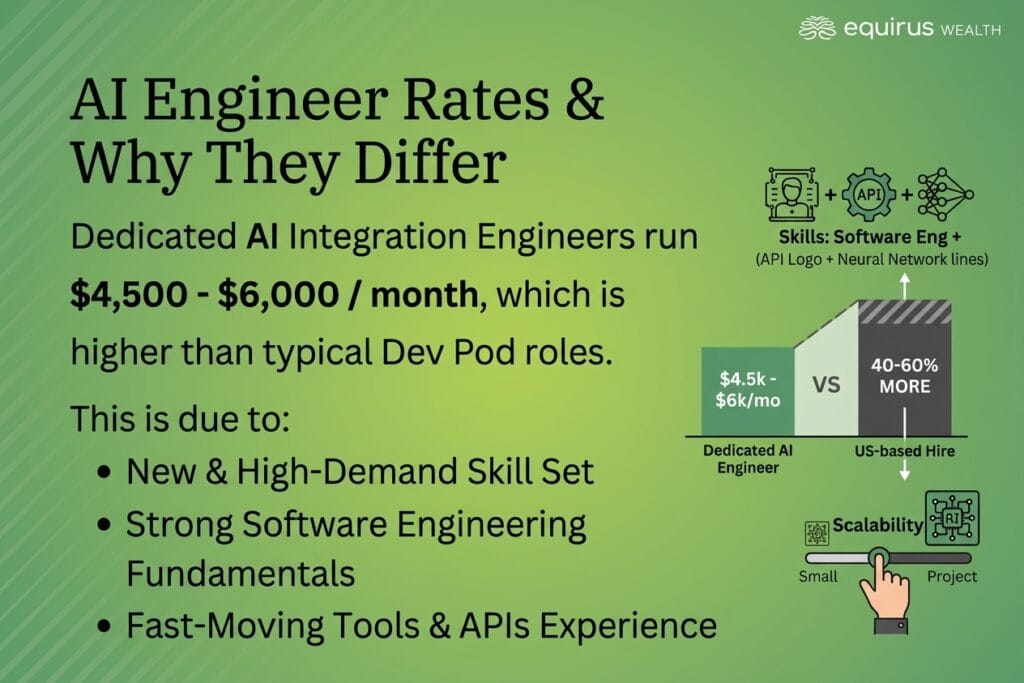
AI Integration Engineers run $4,500-6,000/month on a dedicated basis — noticeably higher than most other Dev Pod roles. That’s because the skill set is newer, in higher demand, and requires both strong software engineering fundamentals and current, hands-on experience with a fast-moving set of tools and APIs that didn’t exist in their current form a few years ago.
Even at that higher band, it’s still 40-60% below what an equivalent specialist costs as a US-based hire — and far below what most 10-50 person agencies could justify as a full-time headcount given how project-based AI feature requests tend to be right now.
A real example of what this looks like in practice
One relevant build: an AI-driven workforce development platform for a Canadian client (Trynexa), where the AI component wasn’t a bolt-on chatbot but a core part of how the platform matched people to opportunities — requiring genuine integration between the AI layer and the underlying data and business logic, not just a conversational interface sitting on top.
That’s the difference between “AI feature” as a marketing checkbox and AI integration as real, differentiated product work — and it’s why the role commands a premium over general full-stack development.
How to bring this capability into your agency without over-committing
Given how project-based AI requests currently are for most agencies, a dedicated AI integration engineer on a staff augmentation basis — brought in for the specific client project, scaled down or reassigned once it ships — makes more sense than a full-time hire for most 10-50 person shops right now.
CTA: Book a 15-minute call and we’ll show you 2-3 AI Integration Engineer profiles so you can scope your next AI feature request properly. More at nextpak.org/agencies.