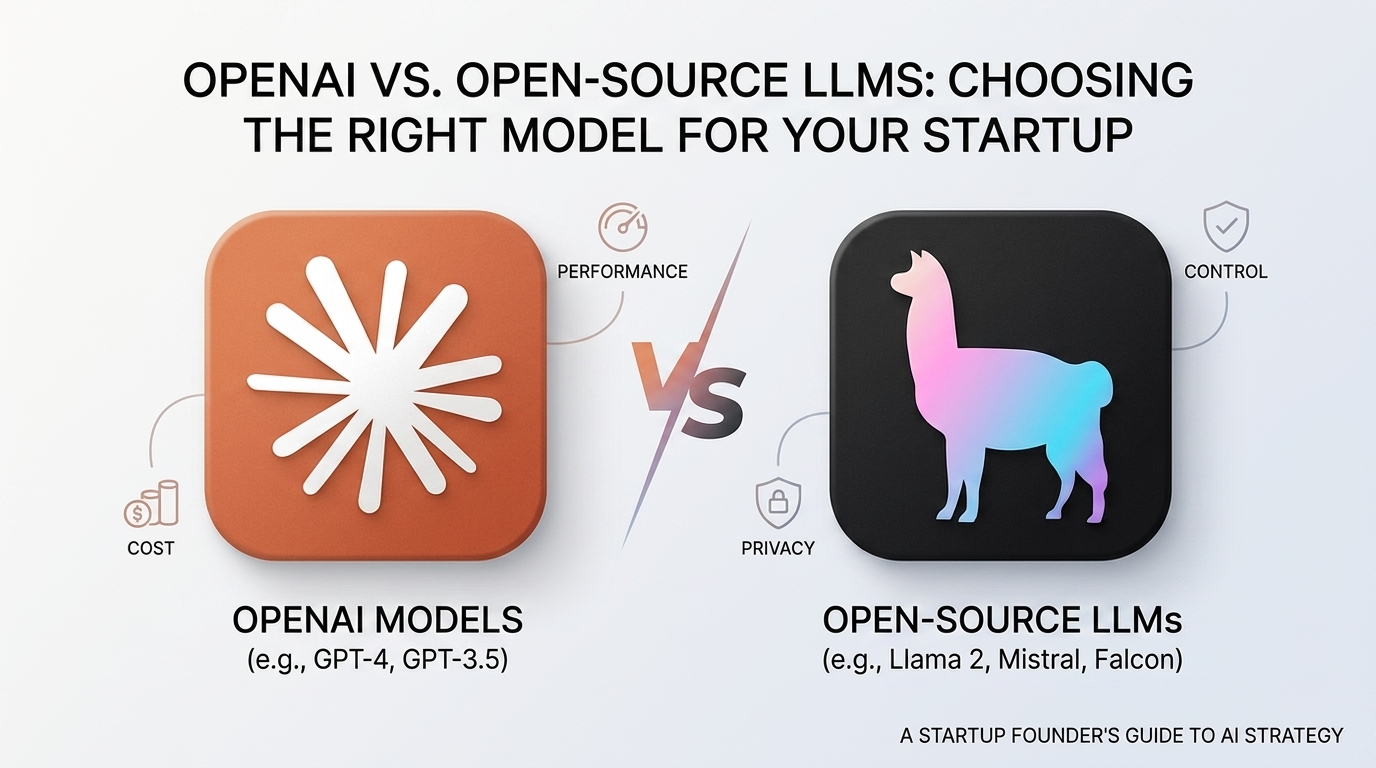
Start with what’s actually your moat
The first question isn’t technical, it’s strategic: is this AI capability the thing customers are paying you for, or is it plumbing that makes your real product work? If a fintech startup is building fraud detection as its core differentiator, that model and its training data are the moat — build it, own it, iterate on it constantly. If that same startup needs a chatbot to answer “what’s my account balance” in natural language, that’s plumbing. Use an LLM API and move on.
A useful test: if a competitor could buy the exact same vendor tool you’re using and get 80% of the value, that capability isn’t your moat. Don’t over-invest engineering time defending ground that isn’t strategic.
The buy case: APIs and vendor tools
For most startups, “buy” doesn’t mean a full vendor platform — it means building on top of Open AI, Anthropic, or Google’s models via API, plus a managed vector database like Pinecone. This gets you state-of-the-art model quality without a research team, and it lets you ship in weeks instead of quarters.
The buy path makes sense for: conversational interfaces, document summarization, classification tasks, embeddings-based search, and most generative content features. These are commodity capabilities in 2026 — the differentiation is in how well you integrate them into your product workflow, not in the underlying model.
The real cost of “buy” isn’t the API bill, it’s the integration engineering: prompt design, retrieval architecture, error handling, rate limiting, cost controls, and observability. Founders consistently underestimate this. A “simple” GPT-4o integration that handles edge cases, logs for debugging, and degrades gracefully when the API is slow is a multi-week engineering project, not an afternoon.
The build case: when custom makes sense
Custom builds — fine-tuned models, proprietary ML pipelines, custom retrieval architectures — make sense when you have a genuinely unique data asset, when latency or cost at scale rules out API calls, or when compliance requirements mean you can’t send data to a third party at all (common in healthtech and some fintech contexts).
Building custom without one of those three justifications is usually ego, not strategy. We’ve seen technical co-founders spend two months building a custom classification pipeline that a fine-tuned GPT-4o-mini model would have matched in a week, because building felt more like “real engineering.” Runway doesn’t care how satisfying the engineering was.
The third option nobody talks about: scoped build with outside help
Most funded startups aren’t actually choosing between “buy a SaaS tool” and “build with internal headcount.” The real choice is between those two and a third path: bring in outside engineering to build a custom, owned system without hiring a permanent AI team you don’t need yet.
This is where a lot of Series A companies land. You have a technical founder and maybe two backend engineers who are excellent at your core product but have never built a production RAG pipeline or fine-tuned a model. Hiring a full-time AI engineer is a 3-6 month process with real risk of a bad hire, and you may only need that expertise in concentrated bursts around specific features. A scoped engagement — bring in AI engineering expertise for 60-90 days to design and ship the system, then hand it to your team to maintain — gets you an owned, production system without the hiring risk or the vendor lock-in.
This is the model we run at NextPak: we’re not staffing you a rented developer, we’re shipping a working AI system your team then owns and operates. Most engagements land in the $15K-50K+ range depending on scope, which is often cheaper and faster than a bad senior AI hire that doesn’t work out.
A simple decision framework
Ask three questions in order: Is this capability my competitive moat? If no, buy an API and move on. If yes — do I have a genuinely proprietary data advantage or a hard constraint (cost, latency, compliance) that rules out APIs? If no, you probably still don’t need custom. If yes, do I have the in-house expertise to build and maintain this correctly, or do I need to bring in outside engineering to build it right the first time?
Most funded startups land on “buy the commodity parts, build the moat with focused outside help, hire permanent AI headcount only once you know exactly what that person should be doing every day.”
If you’re weighing build vs. buy on a specific AI feature, bring us the actual problem — nextpak.org, short call, no pitch deck required. We’ve been building production AI systems since 2020.