Hiring a developer who can build a feature is not the same as hiring someone who can safely contribute to a system your business depends on. When software supports financial transactions, customer data, healthcare workflows, logistics, or core business operations, a poor engineering decision can create consequences far beyond a delayed sprint.
Remote hiring adds another layer of complexity. You need to assess technical skills, independent decision-making, communication, security awareness, and the ability to work within established engineering standards—without relying on physical proximity.
The key is to vet for production readiness, not just coding ability. A reliable process combines structured interviews, practical technical assessments, security checks, reference verification where appropriate, and a clear evaluation of how developers work within a team.
This guide explains how CTOs, founders, and product managers can evaluate remote developers for critical engineering work and decide when a dedicated software development team is the better fit.
Why Mission-Critical Engineering Requires a Different Vetting Process
For a routine prototype, a limited technical assessment may be enough to identify a promising developer. For mission-critical software, the assessment must go deeper.
Consider a developer who writes a feature quickly but overlooks authorization checks, introduces a database migration that risks existing records, or deploys changes without adequate testing. The code may work in a demonstration while creating problems in production.
The risks usually fall into four categories:
- Operational risk: outages, failed deployments, performance bottlenecks, or difficult recovery.
- Security risk: exposed credentials, weak access controls, vulnerable dependencies, or inappropriate data handling.
- Delivery risk: missed commitments, poor documentation, and unexpected rework.
- Continuity risk: undocumented systems, concentrated knowledge, and dependence on one individual.
The appropriate level of vetting depends on the software’s criticality, regulatory obligations, data sensitivity, and recovery requirements. The goal is not to make every hiring process unnecessarily complicated. It is to match the depth of assessment to the consequences of failure.
What Should You Evaluate in a Remote Developer?
1. Technical competence and system design
A developer should demonstrate more than familiarity with a programming language or framework. Assess whether they understand the system surrounding the code.
Evaluate their ability to:
- Explain architectural decisions and the trade-offs involved.
- Design reliable APIs, data models, and service integrations.
- Identify performance bottlenecks and scalability constraints.
- Work with existing codebases without introducing unnecessary complexity.
- Explain how they would investigate a production defect.
Use realistic scenarios rather than relying exclusively on algorithm puzzles. For example, ask a candidate to explain how they would introduce a new payment-related feature while preserving existing behavior.
Look for clear reasoning, awareness of edge cases, and an ability to justify decisions. The best answer is not always the most sophisticated architecture; it is the solution that fits the requirements and operational constraints.
2. Testing, security, and production readiness
For critical engineering, testing and security cannot be treated as responsibilities that begin after development.
Ask candidates how they approach unit, integration, and end-to-end testing. Explore how they validate error handling, manage database migrations, review dependencies, and respond when a deployment fails.
Security questions should reflect the actual environment. Depending on the role, this might include authentication, authorization, secrets management, least-privilege access, input validation, logging, and sensitive-data handling.
A useful scenario is to ask what a developer would do after discovering that a production service has exposed confidential information. A strong response should prioritize containment, appropriate escalation, evidence preservation, and the organization’s incident-response procedures—not an improvised fix that hides the problem.
3. Communication and accountability
Remote developers often need to make progress without constant supervision. Technical ability alone does not guarantee effective collaboration.
Assess whether candidates can:
- Communicate blockers before they become delivery problems.
- Explain technical decisions to non-technical stakeholders.
- Estimate work while acknowledging uncertainty.
- Document important decisions and implementation details.
- Accept code-review feedback and take responsibility for mistakes.
Ask candidates to describe a difficult technical problem they solved, including what went wrong, what they communicated, and what they learned. Follow-up questions can help distinguish genuine experience from rehearsed answers.
A Step-by-Step Framework for Vetting Remote Developers
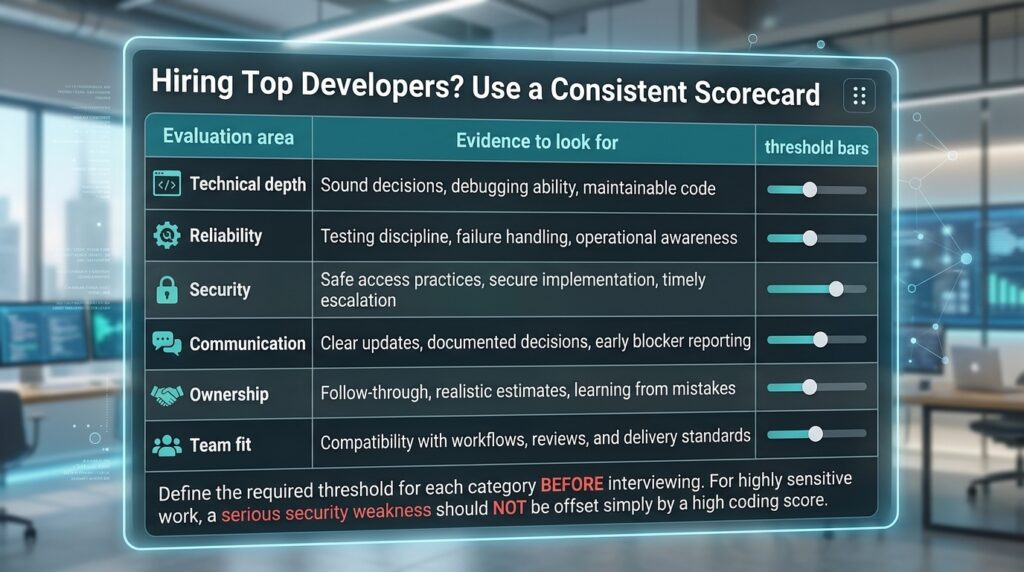
A consistent process makes candidates easier to compare and reduces the influence of subjective impressions.
Step 1: Define the risk profile. Identify the systems the developer will access, the sensitivity of the data involved, the potential impact of failure, and the level of autonomy required. Specify mandatory skills separately from desirable ones.
Step 2: Screen for relevant experience. Review comparable projects, responsibilities, technology choices, and the candidate’s actual contribution. Ask how they handled constraints and production issues rather than judging experience by job titles alone.
Step 3: Conduct a structured technical interview. Give candidates the same core questions and evaluation criteria for the same role. Explore architecture, debugging, testing, security, and trade-off analysis according to the work involved.
Step 4: Use a realistic practical assessment. A focused code review, debugging exercise, or system-design discussion can reveal how candidates think. Use a representative task with clear criteria and a reasonable time limit. Avoid requesting substantial unpaid production work.
Step 5: Verify collaboration and accountability. Where appropriate and authorized, check professional references and confirm relevant experience. Discuss communication expectations, review practices, working hours, and escalation procedures.
Step 6: Confirm access and onboarding controls. Before production access, establish identity verification appropriate to the engagement, approved accounts, least-privilege permissions, secret-handling rules, and documented onboarding procedures.
Step 7: Validate performance through a controlled start. Begin with a bounded task, a clear definition of done, appropriate code review, and measurable acceptance criteria. Evaluate both the result and how the developer works within the team’s standards.
Choose the Right Hiring Model for the Work
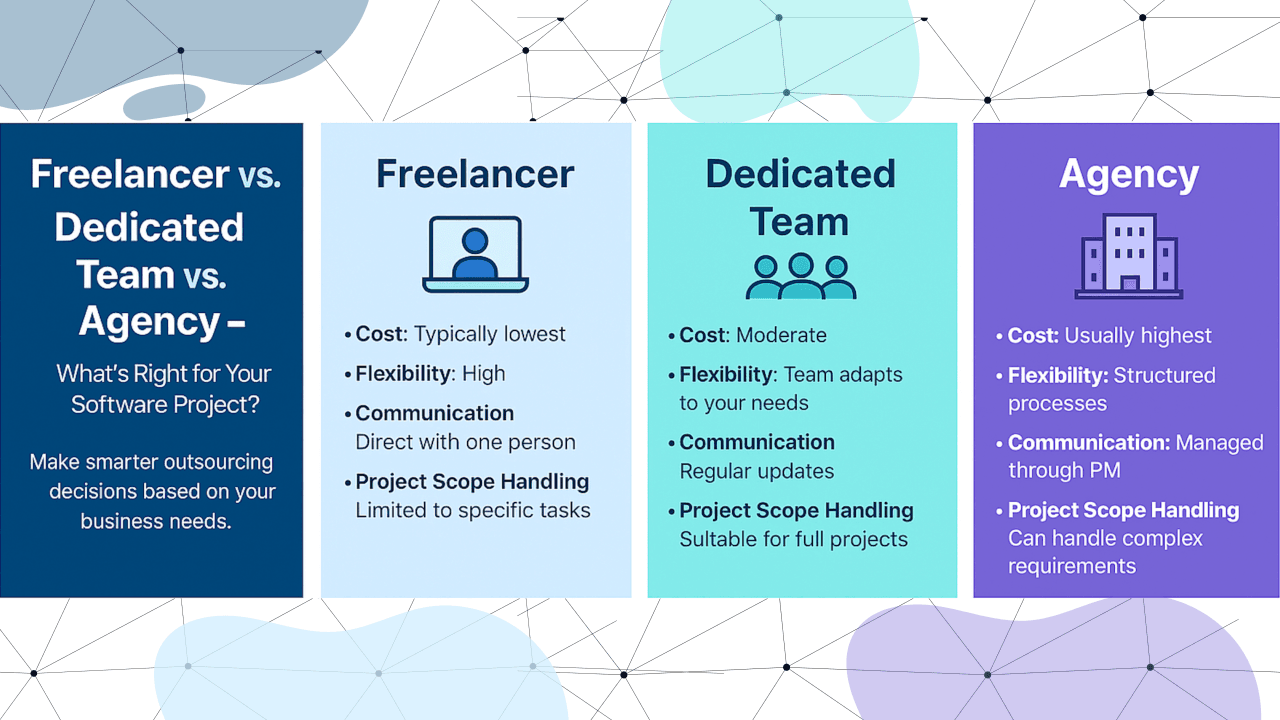
Vetting an individual is only one part of the decision. You also need to determine whether the engagement model provides the necessary engineering coverage.
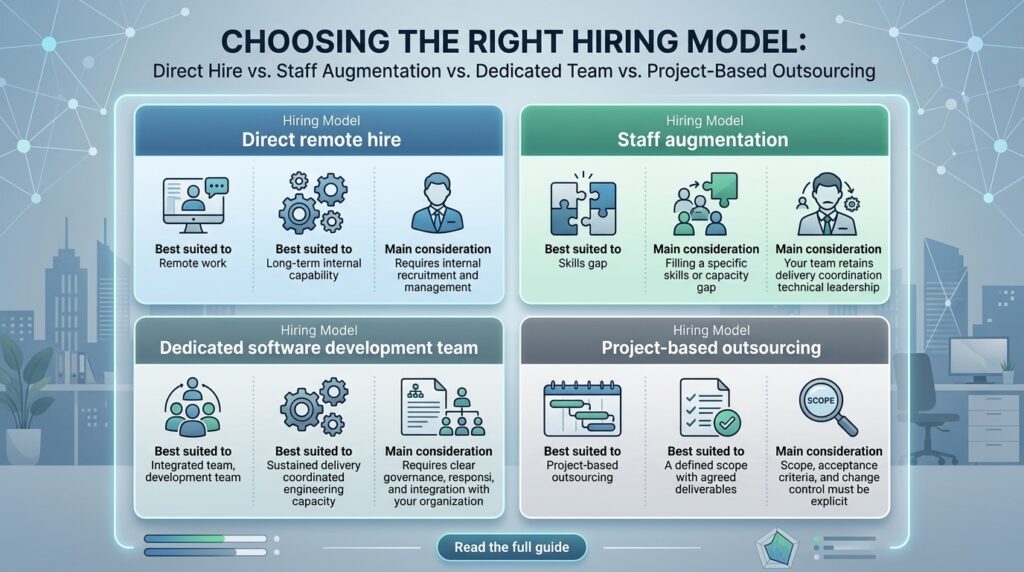
A qualified individual may be ideal for a well-defined task within a mature engineering organization. However, critical systems often require several complementary responsibilities: development, quality assurance, technical leadership, deployment, documentation, and ongoing maintenance.
A dedicated team can provide a coordinated structure for these responsibilities when the engagement includes the capabilities your project needs. It does not automatically guarantee quality; the provider’s screening, processes, and accountability still require evaluation.
Common Mistakes When Vetting Remote Developers
1. Hiring based on résumé keywords. Familiarity with a technology does not prove production experience. Ask candidates to explain actual decisions and constraints.
2. Treating speed as the main measure of competence. Fast implementation can create expensive rework. Evaluate correctness, maintainability, and risk awareness alongside delivery speed.
3. Skipping security assessment. A technically strong developer can still introduce access or data-handling risks. Match security checks to the system’s sensitivity.
4. Using inconsistent interviews. Different questions and standards make comparisons unreliable. Use a shared scorecard and structured evaluation.
5. Ignoring communication habits. Unreported blockers and undocumented changes can damage delivery even when the code is sound. Establish update and escalation expectations early.
6. Granting excessive access too soon. Broad permissions increase potential impact if credentials or systems are compromised. Apply least privilege and expand access only when justified.
7. Failing to plan knowledge transfer. Critical systems should not depend on undocumented individual knowledge. Require useful documentation, code reviews, and shared ownership.
8. Assuming a vendor’s reputation replaces verification. Evaluate the actual developers, technical leadership, quality controls, and contractual responsibilities assigned to your engagement.
When Should You Build Internally or Hire a Specialist?
An internal team may be the right choice when the organization has established recruitment capability, sufficient engineering leadership, and a long-term need to develop proprietary expertise.
External specialists can be useful when you need scarce technical skills, faster access to additional engineering capacity, or a coordinated team without building every role internally. They may also help when an existing team is stretched between maintaining production systems and delivering new features.
Before choosing a provider, ask who conducts technical assessments, who supervises the work, how quality assurance is handled, what security controls apply, and who owns the code and documentation. Clarify communication channels, replacement procedures, continuity arrangements, and responsibility for incidents.
The decision should follow your delivery requirements and risk profile—not a blanket assumption that remote hiring or outsourcing is always more efficient.
How Dedicated Software Development Teams Support Critical Engineering
The underlying challenge is not simply finding developers. It is assembling the right capabilities and ensuring they work within a reliable engineering process.
A dedicated software development team can be appropriate when a product needs sustained development capacity across multiple responsibilities. Depending on the engagement, that may include software developers, technical leadership, QA engineers, and support for integration or deployment.
NextPak’s Dedicated Software Development Teams service is the relevant starting point for organizations exploring this model. Before engaging any provider, confirm the team’s proposed roles, vetting process, security expectations, delivery workflow, and fit with your existing architecture.
A sensible engagement begins with a discussion of your roadmap, technical gaps, critical systems, and acceptance criteria. From there, define the required skills, responsibilities, communication cadence, access controls, and initial deliverables.
The objective is a team that fits your engineering environment and can be evaluated through transparent delivery standards—not simply a list of available developer profiles.
If your organization needs additional engineering capacity for critical systems, review your requirements before deciding whether individual hiring, staff augmentation, or a dedicated team makes the most sense.
Explore NextPak’s dedicated software development team offering to discuss the capabilities your project requires and determine a suitable engagement structure.
Frequently Asked Questions
What should you look for when hiring vetted remote developers?
Assess technical depth, production experience, testing practices, security awareness, communication, accountability, and ability to work within your engineering standards. Use structured interviews and practical exercises relevant to the role.
How do you verify a remote developer’s technical skills?
Combine a review of relevant experience with technical discussions, realistic coding or debugging exercises, system-design questions, and code-review scenarios. Use consistent evaluation criteria and verify professional references where appropriate.
How is vetting developers for mission-critical systems different?
The assessment places greater emphasis on reliability, security, failure handling, testing, access control, documentation, and operational judgment. The depth of screening should reflect the consequences of failure.
Is staff augmentation better than a dedicated development team?
Neither is universally better. Staff augmentation usually fills a specific gap within your existing team, while a dedicated team is more suitable when you need coordinated, sustained engineering capacity. Choose according to the management structure and responsibilities your project requires.
How can remote developers be given secure access to production systems?
Use approved accounts, multifactor authentication where available, least-privilege permissions, secure secret management, audit logging, and documented access-revocation procedures. Production access should follow organizational security policies and be granted only when necessary.
How long does the vetting process take?
It depends on role complexity, seniority, availability, assessment depth, and required checks. Define the essential evaluation stages in advance so that critical checks are not skipped to meet an arbitrary deadline.
What should a dedicated development team engagement include?
Clarify the assigned roles, technical leadership, development workflow, QA responsibilities, documentation, communication cadence, security requirements, ownership of deliverables, and performance expectations. The exact arrangement should match the project’s needs.
NextPak’s Dedicated Software Development Teams can help you explore an engineering structure aligned with your technical requirements, product roadmap, and delivery goals.
Ready to evaluate your options? Discuss your project requirements with NextPak and identify the right development team structure for your needs.
Explore Dedicated Development Teams
CTA: Book a 15-minute call and we’ll show you 2-3 matching developer profiles — no commitment, just options. Check out nextpak.org to see how the model works end to end.