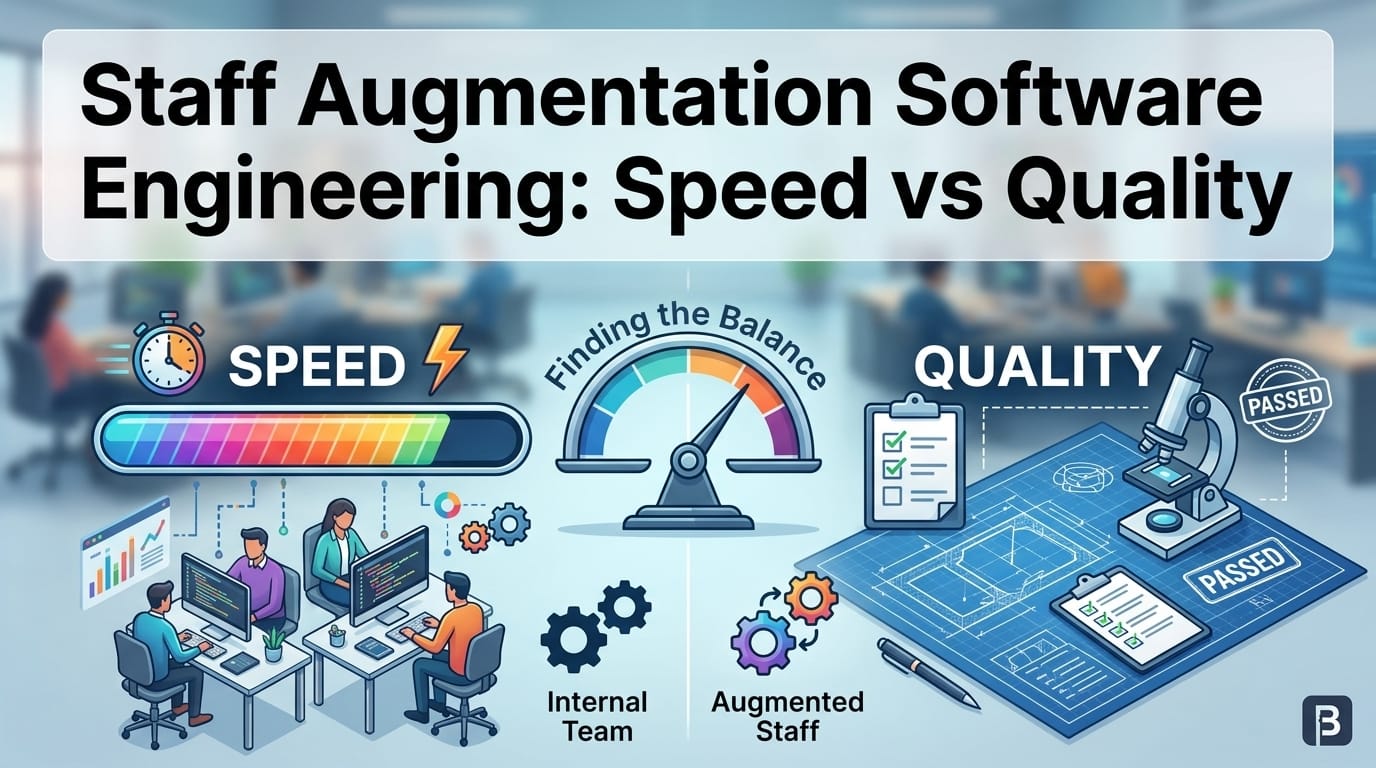
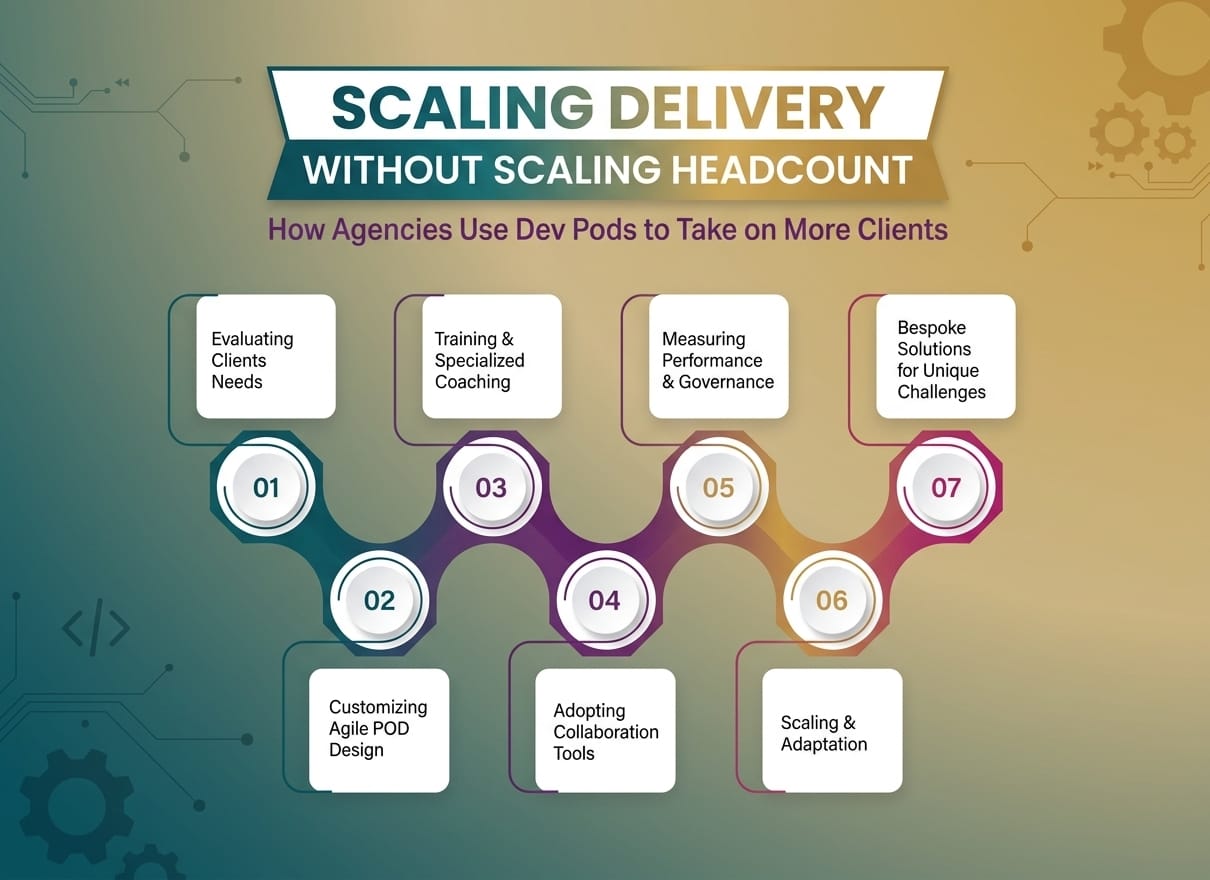
Your product roadmap is growing, but your engineering capacity is not.
That mismatch creates familiar problems: senior developers become overloaded, releases take longer, QA gets pushed toward the end of the sprint, and new projects compete with existing commitments. Hiring permanent employees may solve the capacity problem eventually—but recruitment, onboarding, and technical ramp-up can take time you do not have.
That is where companies start to consider whether to hire dedicated software developers.
But adding developers is not automatically the answer. The better question is: What engineering capability is missing, how much capacity is required, and which hiring model gives you the right balance of speed, control, quality, and scalability?
This playbook explains how to make that decision and what to evaluate before committing to a dedicated development team.
When Should You Hire Dedicated Software Developers?
The strongest reason to hire dedicated developers is not simply “we need more people.” It is that your business has an ongoing engineering requirement that your current team cannot efficiently absorb.
A dedicated team can make sense when:
- Your internal developers are consistently at capacity.
- Your product roadmap has expanded.
- Multiple projects need engineering resources simultaneously.
- You need skills that are difficult to recruit internally.
- Permanent recruitment is taking longer than the project timeline allows.
- You need additional capacity without immediately increasing permanent headcount.
- You expect the workload to continue but are not ready to build another internal department.
The key is to identify the delivery gap first. You may need two developers, a complete product squad, specialist expertise, or technical leadership—not simply “more developers.”
Why Engineering Capacity Becomes a Business Problem
Engineering bottlenecks rarely remain inside engineering.
When developers are overloaded, feature delivery slows. QA may receive builds late. Product managers have to reprioritize constantly. Technical debt accumulates because teams prioritize urgent delivery over maintainability.
Consider a hypothetical SaaS company with several major features planned for the next quarter. It might appear that adding developers is the obvious solution. But if the real constraint is architecture, QA capacity, or unclear technical ownership, adding developers may increase coordination overhead without improving delivery.
This is why dedicated development should be treated as a capacity and delivery strategy, not simply a recruitment shortcut.
What Does a Dedicated Software Development Team Provide?
A dedicated software development team is an external engineering group assigned to a client’s ongoing product or project requirements.
Depending on the engagement, it can include:
- Frontend or full-stack developers
- Backend developers
- QA engineers
- Technical leads
- DevOps or cloud specialists
- Other technical specialists
The important distinction is continuity. Instead of receiving an individual developer for a narrowly defined task, the business can build a team that becomes familiar with its codebase, architecture, workflows, product requirements, and delivery standards.
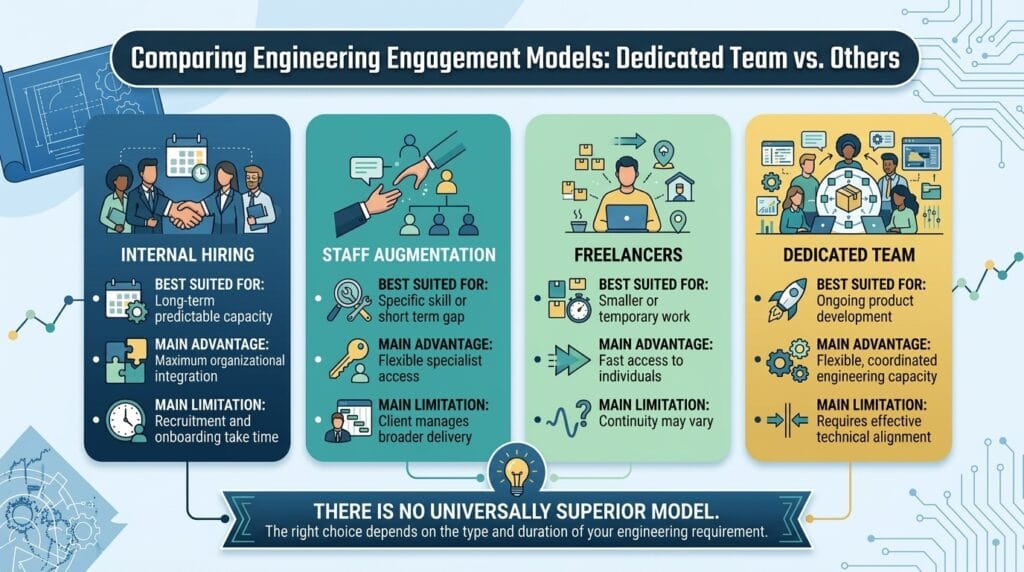
There is no universally superior model. The right choice depends on the type and duration of your engineering requirement.
How to Hire the Right Developers
A strong hiring process starts with the work—not the technology list.
1. Define the delivery gap
Determine whether the constraint is frontend, backend, mobile, QA, DevOps, architecture, or overall engineering capacity.
For example, if developers are completing features but releases repeatedly wait for testing, hiring another developer may not solve the bottleneck. A QA engineer may create more impact.
2. Define technical requirements
Document the technologies and capabilities genuinely required:
- Programming languages and frameworks
- APIs and integrations
- Database technologies
- Cloud infrastructure
- Testing practices
- Security requirements
- Existing architecture
- Domain knowledge
- Required seniority
Avoid turning the requirement into a giant technology checklist. Production experience and problem-solving ability often matter more than familiarity with every tool on the stack.
3. Evaluate engineering capability
Do not evaluate developers only through interviews.
Look at how candidates approach:
- Existing code
- Debugging
- Architecture decisions
- Testing
- Code reviews
- Version control
- Performance issues
- Maintainability
- Technical trade-offs
The objective is to determine whether someone can contribute to a real production environment—not simply answer technical questions correctly.
4. Establish ownership
Before development begins, clarify who owns architecture, pull requests, technical decisions, QA coordination, deployment, documentation, and communication.
Without clear ownership, even a technically strong team can become slow.
Dedicated Team or Internal Hiring?
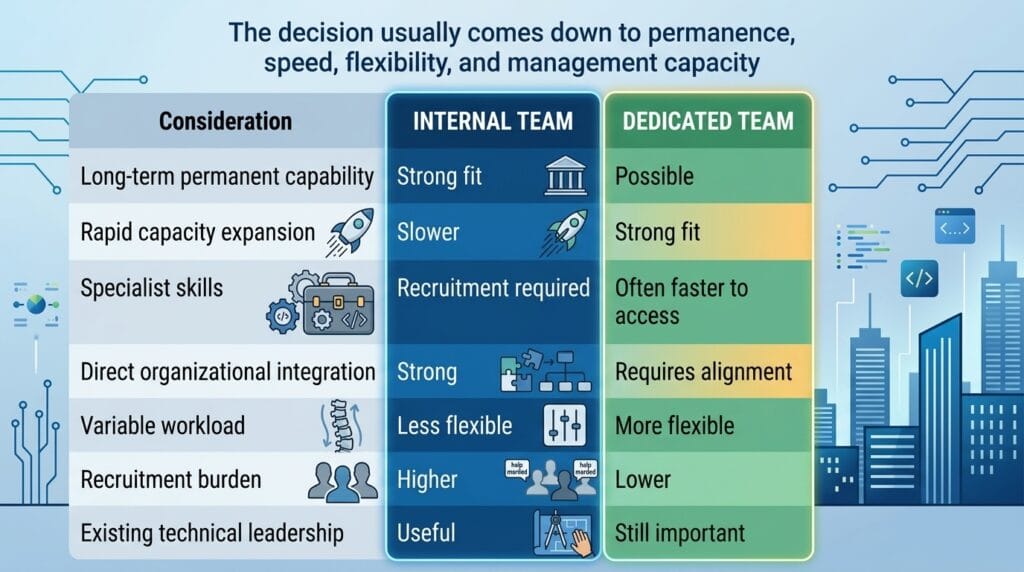
A business expecting stable engineering demand for years may prefer internal hiring. A business facing an expanding roadmap, specialist shortage, or immediate delivery pressure may benefit more from a dedicated team.
Common Mistakes When Hiring Dedicated Developers
1. Hiring based only on technology keywords
Knowing a framework does not prove production-level engineering ability. Evaluate depth, architecture, debugging, and maintainability.
2. Adding developers without identifying the bottleneck
More developers cannot fix every delivery problem. Identify the actual constraint first.
3. Treating QA as an afterthought
If testing is already delaying releases, development capacity alone may increase the testing backlog.
4. Ignoring technical ownership
A team without clear decision-making responsibility can become dependent on the client’s already-overloaded engineers.
5. Building a larger team than necessary
More people introduce more communication and coordination. Start with the smallest team capable of addressing the actual constraint.
6. Neglecting documentation
Architecture decisions, coding standards, deployment procedures, and product knowledge should not remain inside individual developers’ heads.
How a Dedicated Development Engagement Works
A professional engagement should have a defined operating model rather than simply placing developers into a project.
Discovery → Team Design → Technical Alignment → Development → QA → Deployment → Optimization
During discovery, requirements, architecture, existing systems, and delivery objectives are reviewed.
During team design, the required roles and seniority are determined.
Technical alignment establishes development standards, communication processes, repositories, environments, and ownership.
Development then follows the agreed workflow, with code review and QA integrated into delivery rather than treated as final-stage activities.
After deployment, monitoring, feedback, technical debt management, and optimization help the team remain aligned with changing product requirements.
When Does It Make Sense to Work With a Specialist?
You may not need an external team if your internal engineering organization already has the capacity, expertise, and technical leadership required.
A specialist becomes more valuable when:
- Your hiring timeline is longer than your delivery timeline.
- Your team lacks a specific technical capability.
- Multiple products or projects need simultaneous support.
- Internal developers are overloaded.
- You need to scale engineering capacity without immediately creating permanent positions.
- You need developers plus supporting capabilities such as QA or DevOps.
The deeper challenge is often not finding developers. It is creating reliable engineering capacity without adding another management bottleneck.
Why Dedicated Software Development Teams Can Solve That Problem
A dedicated team becomes useful when the requirement extends beyond one missing developer.
The engagement can combine developers and supporting technical roles around a defined product roadmap. That gives the client a more coordinated delivery structure while retaining control over requirements, priorities, and product direction.
A qualified provider should be able to demonstrate:
- Relevant technical expertise
- Flexible team composition
- Clear communication processes
- Code quality and QA practices
- Technical leadership
- Documentation and knowledge transfer
- Transparent ownership and delivery expectations
How NextPak Approaches Dedicated Development
NextPak provides dedicated software development teams for businesses that need additional, ongoing engineering capacity.
The engagement can be structured around the client’s technical requirements, existing architecture, roadmap, and delivery workflow. Depending on the project, capabilities can include full-stack development, QA and testing, technical development, and related engineering support.
The process should begin with understanding the technical gap rather than assigning a predetermined number of developers. From there, the team structure, responsibilities, communication model, and delivery process can be aligned with the client’s requirements.
For businesses evaluating whether they need individual specialists, staff augmentation, or a broader engineering team, this approach allows the engagement model to follow the actual problem.
Final Takeaway
Hiring dedicated software developers should begin with a delivery problem, not a headcount target.
Identify your bottleneck, define the capabilities required, determine whether the need is temporary or ongoing, and then compare internal hiring, staff augmentation, freelancers, and dedicated development teams.
If your roadmap requires sustained engineering capacity but permanent expansion is not the right immediate answer, a dedicated team can provide a practical middle ground between hiring internally and managing disconnected contractors.
Not sure whether you need additional developers, specialist staff augmentation, or a complete dedicated engineering team? Start by assessing your roadmap, technical gaps, and delivery requirements. That gives you a clearer basis for choosing the right engagement model.
FAQs
What does it mean to hire dedicated software developers?
It means working with developers assigned to your ongoing product or project requirements, typically with a longer-term focus and deeper familiarity with your technical environment.
How many developers should I hire?
There is no universal number. Start with the bottleneck and workload, then determine the smallest team capable of addressing the requirement effectively.
What is the difference between dedicated developers and staff augmentation?
Staff augmentation typically adds individual specialists to an existing team. A dedicated team can provide a broader, coordinated engineering capability around ongoing requirements.
Are dedicated development teams suitable for startups?
Yes, particularly when a startup needs to increase engineering capacity quickly but does not yet want to build a larger permanent engineering organization.
What roles can a dedicated team include?
Depending on requirements, a team may include frontend, backend, or full-stack developers, QA engineers, technical leads, DevOps specialists, and other technical roles.
How should I evaluate a dedicated development provider?
Assess technical expertise, relevant experience, communication, QA practices, ownership, documentation, team flexibility, and how clearly the provider explains its delivery process.
Should I hire internally or use a dedicated team?
Internal hiring is often appropriate for predictable, long-term capability. A dedicated team can be useful when you need faster capacity expansion, specialist skills, or greater flexibility.
CTA: Book a 15-minute call and we’ll show you 2-3 matching developer profiles — no commitment, just options. Check out nextpak.org to see how the model works end to end.