Sign 1: You’re saying no to Shopify Plus migrations
Shopify Plus migrations and custom storefront builds require deeper technical skill than most theme customization — Liquid at an advanced level, custom app development, API integrations, sometimes headless builds with React or Next.js on the front end. If your team is comfortable with standard theme edits but not custom app builds, and you’re turning down Plus-tier clients because of it, that’s a clear signal. Plus clients also tend to have bigger budgets and longer retainers — declining them isn’t just lost project revenue, it’s lost recurring revenue.
Sign 2: Dev work is bottlenecking your best people
If your most senior developer is the only person who can touch complex Shopify work, every project routes through them, and everything else — code review, mentoring, other client work — stalls while they’re heads-down on a build. That’s not a scaling problem you fix by asking them to work harder. It’s a capacity problem that needs another set of hands.
Sign 3: You’re quoting dev work at a loss just to keep the client
A common trap: a valuable marketing or design client asks for a Shopify build, you don’t want to lose them to a competitor who can do it all, so you quote the dev work cheap and eat the margin just to keep the relationship intact. That’s a sign you need dev capacity that doesn’t require sacrificing margin to retain clients.
Sign 4: Post-launch support requests are piling up

Shopify sites need ongoing maintenance — app conflicts, checkout extension updates, performance issues, seasonal campaign builds. If these requests are queuing up because nobody owns them, you’re accumulating client frustration in the background even if nothing’s visibly broken yet.
What to actually look for in a white-label Shopify partner
Real Shopify build experience, not general web dev experience treated as interchangeable. Liquid, the Shopify API, theme architecture, and app development are specific skills. Ask for examples of actual DTC storefronts built, not just “we know Shopify.”
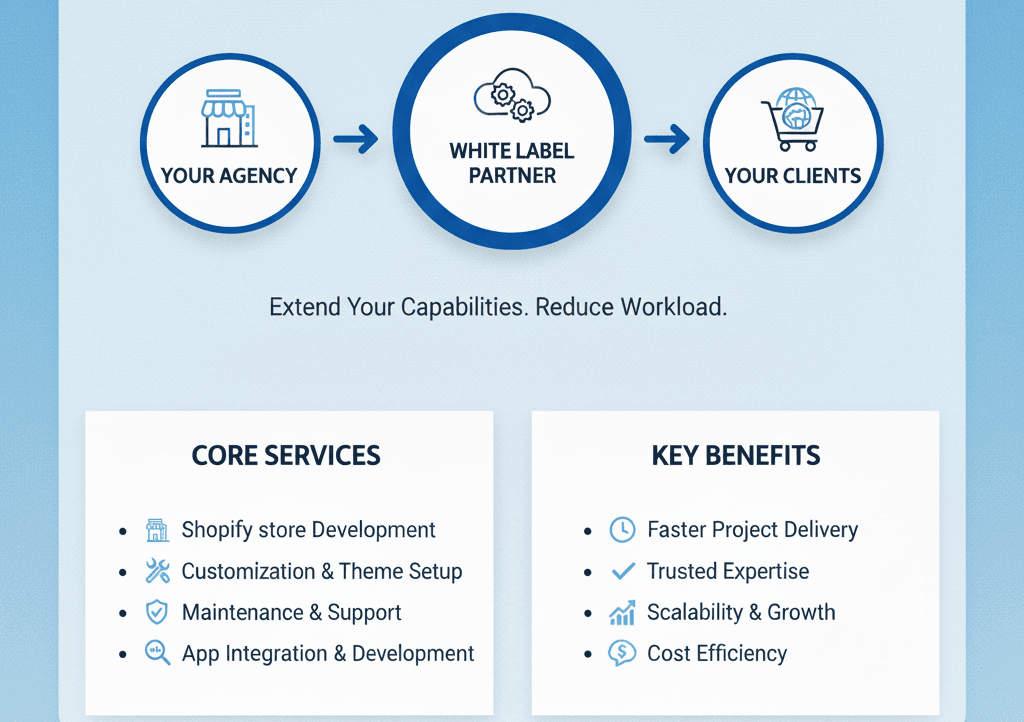
Comfort working invisibly. The point of white label is that your client never needs to know a third party is involved. That means the developer needs to follow your naming conventions, your Git workflow, your documentation standards — not impose their own.
Fast ramp-up on an existing codebase. Most white-label Shopify work isn’t greenfield — it’s picking up an existing theme or app and extending it. A good developer can get oriented in an existing Shopify codebase within days, not weeks.
Timezone overlap for live campaign support. DTC brands run time-sensitive campaigns — flash sales, product drops — and need same-day fixes when something breaks during a live promotion. A developer who’s offline during your client’s peak traffic hours is a liability, not an asset.
How to bring one in without disrupting client trust
Start with a single, contained project rather than announcing a new “dev team” internally or externally. Bring the developer in on a Shopify build you’d otherwise decline or underquote, run it through your existing project management process, and evaluate the output like you would any new hire’s first project.
If it goes well, you now have a repeatable answer next time a Plus migration or custom build request comes in — instead of scrambling or declining. If it doesn’t go well, you’ve lost a trial period, not a client relationship, provided you picked a partner with a real replacement guarantee.
The compounding effect
Once you have reliable Shopify dev capacity, something shifts in how you pitch new business. You stop qualifying prospects based on “can we build this” and start qualifying based on “is this a good client” — which is a much better position to sell from. Development capacity stops being your constraint and becomes just another line item you can flex up or down per project.
CTA: Book a 15-minute call and we’ll show you 2-3 Shopify-experienced developer profiles ready to start within a week — see the full model at nextpak.org/agencies.