
Sign 1: You’ve turned down three or more projects in the last six months for the same reason
If you’re consistently saying no to a specific category of work — mobile apps, custom integrations, Shopify Plus builds, whatever it is — because you don’t have the capacity, that’s not a one-time gap. That’s a recurring revenue stream you’re leaving on the table every single time it comes up. Track it for a quarter: write down every project you declined and why. If the same “we can’t do X” reason shows up three or more times, you have clear evidence, not just a hunch, that it’s worth solving structurally.
Sign 2: You’re referring work to competitors who then poach the relationship
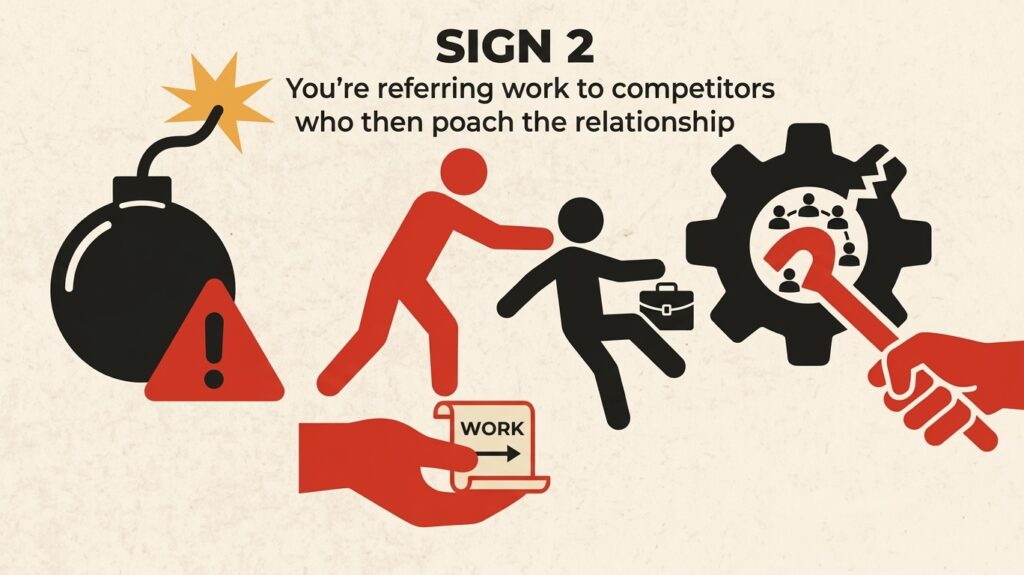
This is the most expensive version of the capacity gap. You refer a client to another shop for the dev work you can’t do, and eighteen months later that client has quietly consolidated everything — including the marketing or design work you used to own — with the shop you referred them to. It happens more often than agency owners like to admit, because once a client trusts another vendor with technical delivery, that vendor is well-positioned to make a broader pitch.
Sign 3: Your best developer (if you have one) is a single point of failure
If there’s one person on your team who handles anything technically complex, and projects stall whenever they’re on vacation, sick, or just overloaded, you don’t have a scalable capability — you have a fragile dependency. This is a common state for 10-25 person agencies that grew a design or marketing practice first and added “someone who can code” almost as an afterthought. It works until it doesn’t, usually right when that person is unavailable and a client needs something urgently.
Sign 4: Dev work is priced inconsistently because you don’t have a reliable cost basis
If your team is quoting development work based on gut feel rather than a real, repeatable cost structure — because every project requires figuring out capacity from scratch — you’re probably either overpricing (and losing deals) or underpricing (and eating margin) more often than you realize. A dedicated Dev Pod gives you a known, fixed monthly cost you can build predictable margins around, project after project, instead of re-deriving pricing logic every time.
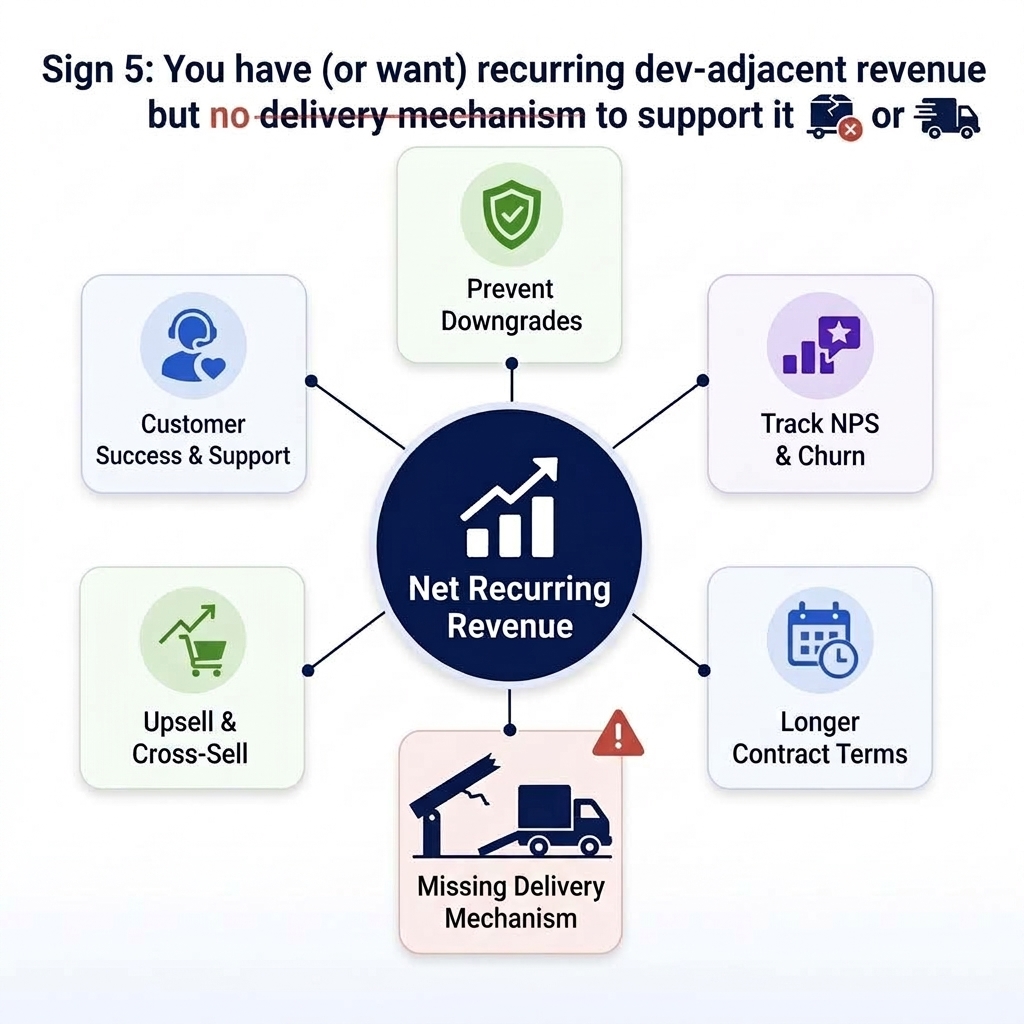
Sign 5: You have (or want) recurring dev-adjacent revenue but no delivery mechanism to support it
If your growth strategy involves expanding retainers to include ongoing website or app maintenance, ongoing Shopify optimization, or continuous feature development — anything recurring rather than project-based — you need development capacity that’s also recurring and reliable, not ad hoc freelancers stitched together per request. Recurring revenue promises require recurring delivery capacity behind them; otherwise you’re selling something you can’t consistently fulfill.
What “ready” actually looks like in practice
You don’t need all five signs simultaneously to justify adding a Dev Pod — even two or three is usually enough signal. What you’re really solving for is predictability: turning an ad hoc, stressful scramble into a known process with a known cost, so that the next time a client asks for something outside your current bench, the answer is “yes, give us a few days,” not “let us check and get back to you,” followed by an awkward silence.
Why “add one dedicated developer” beats “hire in-house” as the first move
Even if the long-term plan is eventually building an in-house dev team, starting with a dedicated Dev Pod developer lets you validate real demand — how much dev work actually flows through your agency in a typical quarter — before committing to the fixed cost and hiring risk of a local employee. Agencies that skip this step and hire in-house first sometimes discover the demand is lumpier than expected, and end up with expensive, underutilized headcount in slow months.
A Dev Pod developer can also start within five to seven days once you decide to move, compared to a multi-week or multi-month hiring cycle for an in-house role — which matters when the signal (a declined project, a frustrated client) is happening right now, not in a hypothetical future quarter.
Starting small is the point, not a compromise
You don’t need to commit to a five-person pod on day one. Most agencies start with a single developer matched to their most common unmet request — often a full-stack or Shopify developer — and expand from there once the model proves out inside their actual delivery process.
CTA: If two or more of these signs sound familiar, book a 15-minute call and we’ll show you 2-3 developer profiles matched to the work you’ve been turning down. Details at nextpak.org/agencies.