Your product roadmap is growing, customers are requesting new features, and deadlines are becoming harder to meet. Yet hiring full-time engineers takes time, your existing team is already stretched, and rushing new developers into production can create quality problems.
The challenge is not simply adding more people. It is increasing engineering capacity without sacrificing code quality, collaboration, delivery speed, or long-term technical direction.
For growing businesses, dedicated developers can provide a structured way to expand development capacity around specific product goals. The key is to define the right team structure, establish clear ownership, integrate developers into existing workflows, and measure progress against meaningful outcomes.
This guide explains how to scale engineering teams with dedicated developers, when this model makes sense, how it compares with other hiring approaches, and what to evaluate before choosing a development partner.
What Does Scaling an Engineering Team with Dedicated Developers Mean?
Scaling an engineering team with dedicated developers means engaging developers who work consistently on your product, project, or engineering roadmap rather than hiring for a single isolated task.
Depending on the engagement, the team may include frontend and backend developers, full-stack engineers, QA specialists, and technical leadership. Your business defines priorities and product objectives, while the working arrangement determines how development, reporting, and technical decisions are managed.
Unlike short-term task-based outsourcing, a dedicated team is intended to develop familiarity with your codebase, business requirements, users, and delivery processes over time.
The objective is not to maximize headcount. It is to build the engineering capacity needed to deliver and maintain your product sustainably.
When Should You Consider Dedicated Developers?
A dedicated development model may be appropriate when your current team cannot meet demand consistently or when recruiting permanent employees would delay important work.
Look for these signals:
- Growing backlog: New features continually push existing commitments into later sprints.
- Specialized skill gaps: Your team needs expertise in a framework, integration, or technical area that is not available internally.
- Unpredictable workload: Project demand fluctuates, making immediate permanent hiring difficult to justify.
- Expanding product scope: Your software requires parallel workstreams, such as frontend development, backend services, and automated testing.
- Maintenance pressure: Existing engineers spend so much time fixing issues that new development slows down.
However, additional developers will not automatically solve poor prioritization, unclear requirements, or slow decision-making. Diagnose the bottleneck first. If the real problem is architectural instability or an overloaded approval process, more developers may simply increase coordination costs.
How to Scale Engineering Teams with Dedicated Developers
1. Identify the Actual Engineering Bottleneck
Start by examining why delivery is slowing down. Review the product backlog, sprint commitments, unresolved defects, release frequency, and dependencies between teams.
Separate capacity problems from process problems.
For example, if backend development is delaying every release because the same two engineers handle all API work, adding backend capacity may help. If developers are waiting days for product decisions, hiring more engineers will not remove that dependency.
Define the specific outcome you need: faster feature delivery, reduced backlog, improved test coverage, specialist expertise, or support for a new product initiative.
2. Define the Team Structure
Choose roles based on the work that needs to be completed, not on an arbitrary headcount target.
A smaller initiative may require one or two developers working with your existing technical lead. A broader product roadmap may need a dedicated group covering frontend, backend, QA, and technical coordination.
Before hiring, clarify:
- Required technical skills and experience.
- Responsibilities and decision-making authority.
- Expected collaboration with internal employees.
- Testing, documentation, and code-review requirements.
- Availability, time-zone overlap, and communication expectations.
A clear role definition reduces mismatches and helps the team contribute sooner.
3. Choose the Right Engagement Model
Dedicated developers are one option for increasing capacity, but they are not always the best fit.
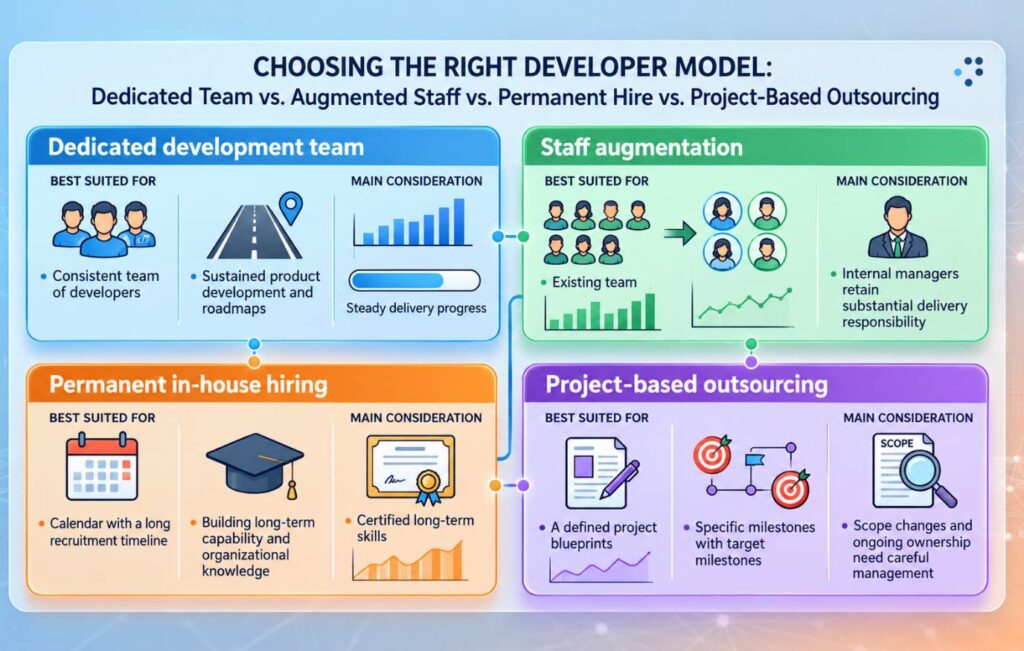
The right choice depends on workload duration, internal management capacity, budget, technical complexity, and how much control you need over day-to-day development.
4. Integrate Developers into Your Existing Workflow
A dedicated team should not operate as an isolated group that receives occasional instructions. Integrate its members into the systems your engineers already use.
Provide access to relevant repositories, development environments, documentation, issue trackers, communication channels, and deployment procedures. Establish expectations for pull requests, code reviews, testing, sprint planning, and incident escalation.
Assign an internal product owner or technical lead to clarify requirements and resolve dependencies. Document architectural decisions so that knowledge is not trapped in private conversations or with one developer.
A structured onboarding process helps new team members understand not only how the software works, but also why particular decisions were made.
5. Establish Quality and Security Standards
Increasing development capacity without maintaining engineering standards can create technical debt that slows future releases.
Set expectations for code review, automated testing, coding conventions, documentation, access permissions, and release approvals before development accelerates.
Security requirements should reflect the product and data involved. Use least-privilege access, approved development tools, secure credential management, and appropriate review of dependencies and third-party integrations.
Define who owns production access, code repositories, infrastructure, and technical documentation. These responsibilities should be explicit in the working agreement rather than assumed.
6. Measure Outcomes, Not Just Activity
The number of developers hired or tasks completed does not prove that scaling is successful.
Track measures connected to your original bottleneck, such as:
- Lead time from starting work to delivery.
- Sprint completion against realistic commitments.
- Defect rates and production incidents.
- Automated test coverage where relevant.
- Deployment frequency and recovery time.
- Backlog reduction and delivery predictability.
Establish a baseline before the team begins. Review trends regularly and interpret metrics in context. For example, a temporary increase in defects during a major migration may require investigation rather than an immediate conclusion about developer performance.
7. Scale Gradually as Demand Changes
Avoid expanding the team before there is enough prioritized work to support it. Start with the capacity required for the next meaningful delivery milestone, evaluate how effectively the team collaborates, and adjust the structure as requirements evolve.
As the product grows, responsibilities may need to change. A team that initially focuses on feature development may later require stronger QA automation, DevOps support, or technical leadership.
Review the team structure periodically so that capacity follows business priorities rather than becoming a fixed cost without a clear purpose.
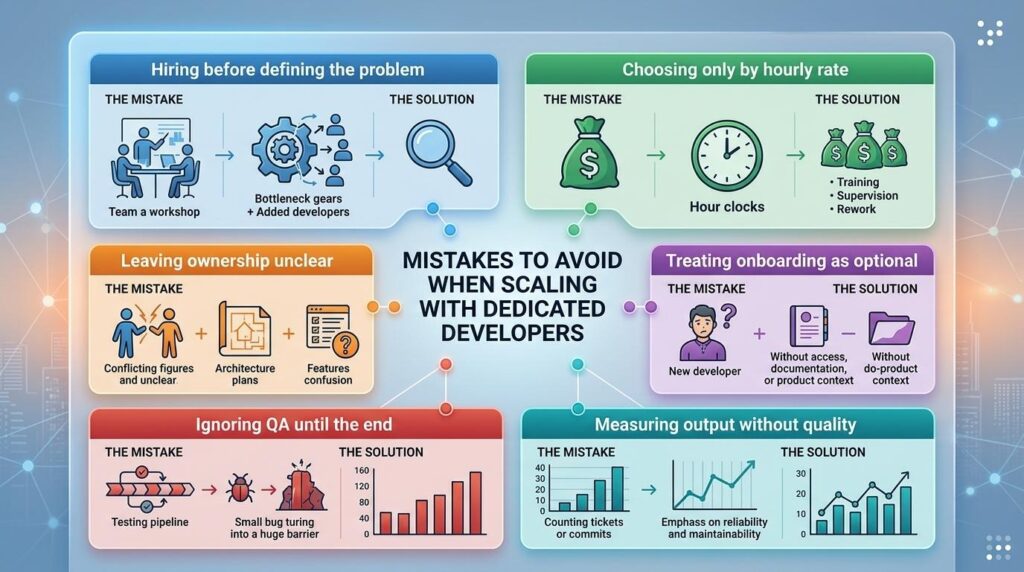
Common Mistakes When Scaling with Dedicated Developers
When Should You Work with a Dedicated Development Partner?
An internal team may be sufficient when the workload is manageable, the required skills are available, and permanent hiring supports your long-term strategy.
A dedicated development partner becomes worth evaluating when your roadmap requires sustained additional capacity, multiple complementary skill sets, or a faster way to establish a working team than recruiting every role individually.
A qualified partner should be able to explain its developer selection process, technical evaluation, communication model, onboarding approach, QA practices, security expectations, and knowledge-transfer arrangements. You should also understand how performance is reviewed and how the engagement can change as requirements evolve.
The service is most useful when it addresses a clearly defined engineering need—not simply when adding external developers seems like the quickest response to pressure.
Scaling Engineering Capacity with NextPak
If your business needs additional engineering capacity but is not ready to build every role through permanent hiring, a dedicated software development team may offer a practical path forward.
NextPak's dedicated team service is the relevant starting point for evaluating this model. Before selecting an engagement, define the technical skills you need, the work the team will own, how it will collaborate with your internal employees, and what delivery outcomes matter most.
A useful first step is to map your product roadmap against your current engineering capacity. This helps identify whether you need additional developers, a broader team structure, specialist support, or improvements to your existing process.
Explore NextPak’s dedicated software development team service to discuss how an external engineering team could fit your requirements.
Frequently Asked Questions
How many dedicated developers should a business hire?
There is no universal team size. Base the decision on workload, technical complexity, dependencies, and management capacity. Start with the roles needed to deliver a defined milestone and expand when demand justifies it.
Are dedicated developers suitable for startups?
Yes, when a startup needs sustained development capacity but wants to avoid recruiting every role permanently. The startup still needs clear product priorities, technical oversight, and an onboarding process.
How long does it take to integrate dedicated developers?
Timing depends on technical complexity, documentation quality, access approvals, and familiarity with the technology stack. Developers may contribute to bounded tasks earlier, while understanding a complex codebase and its architecture takes longer.
What is the difference between dedicated developers and staff augmentation?
Staff augmentation generally adds individual specialists to an existing team managed by the client. A dedicated development arrangement can provide a more consistent group focused on the client's product, with responsibilities and management agreed as part of the engagement.
How can businesses maintain code quality when scaling?
Use consistent coding standards, peer reviews, automated tests, clear acceptance criteria, controlled releases, and regular quality reviews. Include security and documentation in the development process rather than treating them as final-stage checks.
How should a business evaluate a dedicated development provider?
Assess technical skills, communication, onboarding, delivery practices, QA, security, documentation, ownership, pricing transparency, and knowledge transfer. Ask how the provider handles changing requirements and underperformance, and ensure the agreement defines responsibilities clearly.
Final Takeaway
Scaling an engineering team successfully is about more than increasing headcount. It requires identifying the real delivery constraint, choosing the right engagement model, integrating developers into existing workflows, maintaining engineering standards, and measuring outcomes.
Dedicated developers can help businesses expand capacity when the work is sustained and the team is structured around clear goals. With the right planning and partner evaluation, you can grow engineering capability while retaining visibility, ownership, and control over your product's future.
Ready to Scale Your Engineering Team?
When your product roadmap grows faster than your team's capacity, adding developers is only part of the solution. You need the right skills, a clear development process, and a team structure that supports reliable delivery.
NextPak's Dedicated Software Development Teams can help you explore additional engineering capacity aligned with your technical requirements, product goals, and growth plans.
Need support for your next development milestone? Discuss your roadmap and engineering needs with NextPak to explore the right team structure for your business.
Explore Dedicated Development Teams
CTA: Book a 15-minute call and we’ll show you 2-3 matching developer profiles — no commitment, just options. Check out nextpak.org to see how the model works end to end.