
Freelancing: fast, cheap, and fragile
A freelancer is one person, usually juggling three to five other clients, working whenever they have time. You find them on Upwork, Fiverr, or through a referral. There’s no team behind them — if they get sick, take another gig, or just go quiet for a week, your project stalls.
Freelancers make sense for small, well-defined, one-off tasks: a landing page, a bug fix, a quick script. They don’t make sense when a client is paying you monthly retainer for reliable delivery and expects consistent communication. The risk isn’t that freelancers are bad developers — many are excellent. The risk is continuity. You’re one flaky week away from an awkward client call.
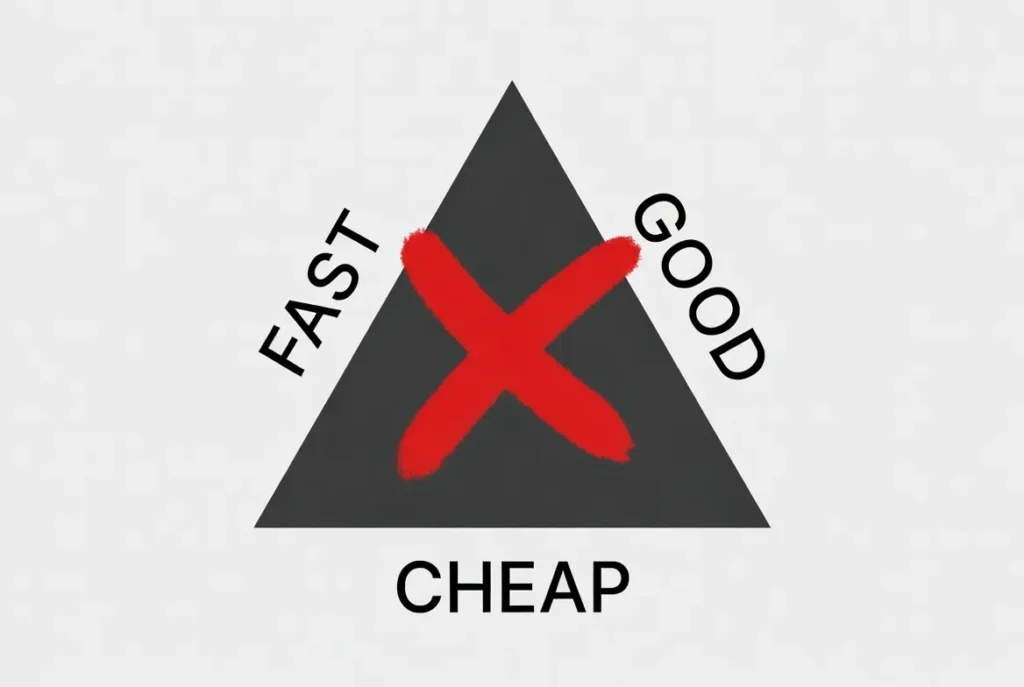
Outsourcing: you hand off the project, not just the labor
Outsourcing usually means handing an entire project or deliverable to a third-party company, who then manages it internally — their PM, their process, their timeline. You get updates, not control. This works when you genuinely want to offload something end-to-end and don’t need visibility into day-to-day work.
The problem for agencies: your clients hired you because they trust your process and your communication style. If you outsource a project wholesale, you lose visibility into how it’s actually being built, and if something goes sideways, you’re explaining someone else’s mistakes to your client without having seen them happen.
Outsourcing also tends to come with heavier markups and less flexibility — you’re often locked into a fixed scope, and changes mid-project trigger renegotiation.
Staff augmentation: you get the person, not just the output
Staff augmentation is different: you add a developer (or a small pod of developers) who works inside your team, your tools, your standups, your timezone overlap — but who’s employed and managed by the augmentation partner. You get day-to-day control without payroll, benefits, or a six-week hiring cycle.
This is the model that actually fits agency delivery, for a simple reason: agencies don’t sell “a developer.” Agencies sell trust, communication, and consistent delivery under their own brand. Staff augmentation lets you keep that intact. The developer works in your Slack, joins your Jira board, reports to your delivery lead, and the client never has to know (or care) that the dev is in Lahore instead of Austin.

Why this distinction actually matters for your margins
If you outsource, you’re paying for a project manager layer, a sales markup, and often a fixed-bid structure that penalizes scope changes — which happen on basically every real project. If you freelance, you’re managing risk yourself with no backup if someone disappears.
Staff augmentation splits the difference: you get dedicated capacity (not shared, not moonlighting) at a price well under a local hire, but you retain the management control an agency needs to protect its client relationships.
At NextPak, this is the whole model. We’re not a bodyshop that takes your spec and disappears for six weeks. We put a dedicated developer — MERN, Node, Vue/Nuxt, mobile, AI integration, whatever the role calls for — directly into your existing workflow. They show up in your standups. They take direction from your delivery lead. If a client asks who’s building their app, the honest answer is “our team,” because functionally, that’s exactly what it is.
The real test: what happens when something goes wrong
This is the question that actually separates these three models. With a freelancer, if things go wrong, you’re stuck — no backup, no accountability structure. With outsourcing, you’re negotiating scope and blame with a vendor who controls the process. With staff augmentation done right, you should have an easy off-ramp: if the developer isn’t the right fit, you replace them, fast, without drama.
That’s why we run every engagement with a week-1 replacement guarantee — not the right fit, we replace at no cost, no questions asked. It’s a small detail, but it tells you a lot about which model actually protects you when the pressure’s on.
If you’ve got a client request you can’t staff right now, book a 15-minute call and we’ll show you 2-3 matching developer profiles — no commitment, just options. Check out nextpak.org/agencies to see how the model works end to end.