The problem RAG actually solves
Large language models like GPT-4o or Gemini 2.0 are trained on a fixed snapshot of public data. They don’t know your customer records, your internal docs, your product catalog, or anything that happened after their training cutoff. Fine-tuning a model on your data is expensive, slow to update, and prone to the model “forgetting” facts or hallucinating details anyway.
RAG sidesteps this. Instead of baking your data into model weights, you keep your data in a searchable store and retrieve the relevant pieces at query time, then hand them to the LLM as context. The model isn’t recalling facts from memory — it’s reading them off a page you just handed it, like an open-book exam. This is why RAG dramatically reduces hallucination on domain-specific questions and lets you update your knowledge base in real time without retraining anything.
What’s actually happening at each step
A production RAG pipeline has four stages, and each one is a place where things break if you skip the details:
Chunking. Your source documents — PDFs, support tickets, contracts, wiki pages — get split into smaller pieces, typically 200-800 tokens. Chunk size matters more than founders expect. Too small and you lose context; too large and you dilute relevance and blow your token budget. Overlap between chunks (usually 10-20%) prevents you from splitting a critical sentence across a boundary.
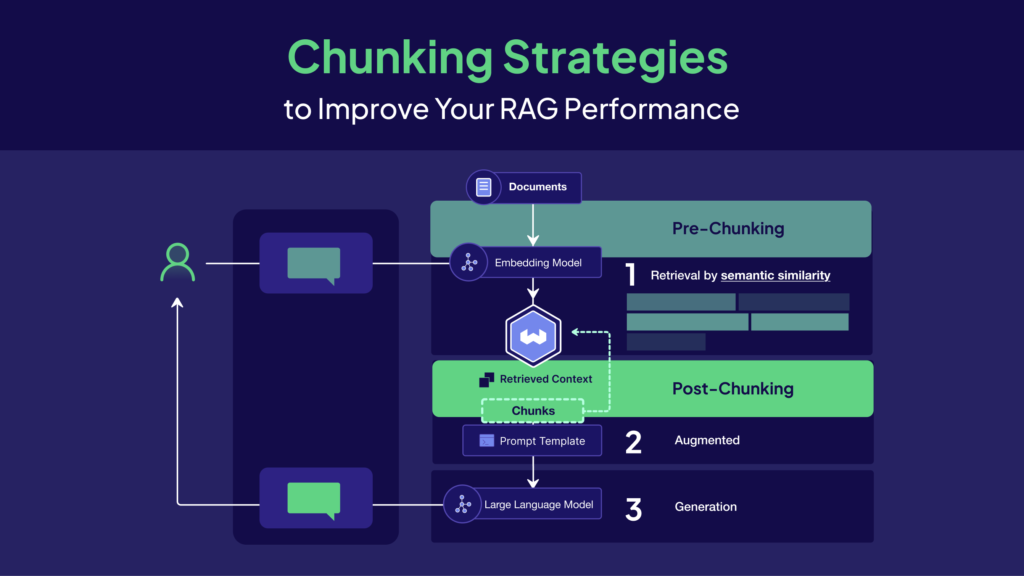
Embedding. Each chunk gets converted into a vector — a list of numbers that represents its meaning — using an embedding model like OpenAI’s text-embedding-3-large or an open-source alternative like BGE. Semantically similar text produces vectors that sit close together in that space.
Retrieval. When a user asks a question, you embed the question the same way and search your vector store for the nearest chunks. This is where pgvector, Pinecone, or Weaviate come in — they’re built to do this nearest-neighbor search fast at scale. Naive top-k similarity search alone is often not enough; production systems layer in hybrid search (combining keyword and semantic matching) and reranking models to actually surface the right chunks.
Generation. The retrieved chunks get inserted into the prompt alongside the user’s question, and the LLM generates an answer grounded in that context. The system prompt matters enormously here — telling the model explicitly to answer only from provided context, and to say “I don’t know” when the context doesn’t cover the question, is what separates a trustworthy internal tool from a liability.
Where founders get this wrong
The most common mistake is treating RAG as a solved problem you can wire up in a weekend with LangChain defaults and ship. The defaults work fine for a demo. They fall apart on real data — messy PDFs, inconsistent formatting, documents that reference other documents, or domains (legal, medical, financial) where “close enough” retrieval produces confidently wrong answers.
The second mistake is skipping evaluation. If you don’t have a test set of real questions with known-correct answers, you have no way to know if a change to your chunking strategy or embedding model made things better or worse. You’re flying blind on your own product.
The third is ignoring retrieval quality in favor of prompt engineering. If your retrieval step surfaces the wrong chunks, no amount of prompt tuning fixes the answer. Most RAG debugging time should go into retrieval, not the generation prompt.
When RAG is the right call
RAG makes sense when your product needs to answer questions grounded in a specific, changing body of knowledge — internal documentation, customer records, compliance material, a knowledge base. It’s the right architecture for AI chat over your product’s help docs, a research assistant over case law or medical literature, or an internal tool that lets support reps query customer history in plain English.
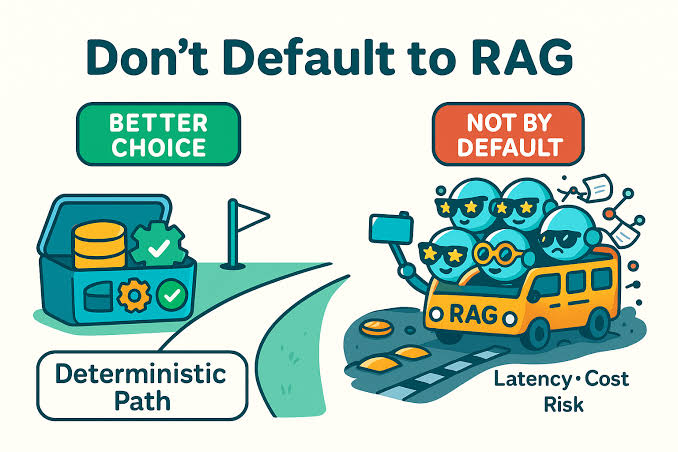
It’s the wrong tool if you just need structured data lookups (that’s a database query, not an LLM call) or if your knowledge base is small enough to fit entirely in a single prompt’s context window — sometimes the simplest solution is no retrieval system at all.
We’ve built RAG pipelines for fintech, healthtech, and workforce-platform clients where retrieval accuracy directly affects trust in the product. The pattern that works isn’t exotic — it’s disciplined chunking, hybrid retrieval, reranking, and an evaluation harness from day one.
If you’re scoping a RAG feature and want a second opinion on architecture before you commit engineering time, book a short call with NextPak at nextpak.org — we’ve been building production AI systems since 2020, well before RAG had a name.