When an engineering roadmap starts moving faster than your hiring pipeline, staff augmentation can look like the obvious answer. Add experienced developers, fill the skill gap, and get more work into the sprint.
But adding engineers does not automatically mean shipping faster.
In software engineering, speed depends on more than headcount. Onboarding, technical leadership, communication, code reviews, architecture, testing, and decision-making all affect how quickly additional capacity turns into production-ready software.
That creates an important question for CTOs, founders, and product leaders: Does staff augmentation actually improve engineering speed without compromising quality?
The answer is yes—when the existing team has the structure to absorb additional engineers. When that structure is missing, a dedicated software development team may be the better model.
The Short Answer: Speed and Quality Depend on Structure
Software engineering staff augmentation works by adding external developers or specialists to an existing engineering organization. The augmented engineers typically work within the client’s tools, backlog, processes, meetings, and technical direction.
This makes the model particularly useful when the problem is a specific capacity or skill gap.
However, your internal team generally remains responsible for priorities, architecture, task assignment, reviews, and delivery coordination. That means the organization gains engineering capacity but also takes on additional coordination responsibilities.
A dedicated development team is different. Instead of adding individual engineers to an existing structure, the organization can engage a stable, cross-functional team designed around a product or long-term workstream.
So the real question is not simply:
“Which model is faster?”
It is:
“Where is the bottleneck—engineering capacity or engineering coordination?”
What Staff Augmentation Software Engineering Actually Solves
Staff augmentation is most effective when you already have an engineering system that works but do not have enough people to execute the roadmap.
For example, a product team may have:
- A defined technical architecture
- An experienced CTO or engineering manager
- Established development standards
- A working sprint process
- Existing QA and code-review practices
- A backlog that exceeds current capacity
In that situation, bringing in a React developer, backend engineer, DevOps specialist, QA engineer, or other technical resource can help the team increase capacity without changing its overall structure.
The augmented engineer becomes an extension of the existing team rather than a separate delivery organization.
This distinction matters because staff augmentation is not a substitute for engineering leadership. The client still needs people who can define priorities, review work, resolve blockers, and maintain technical standards.
Where Speed Can Improve
The strongest argument for staff augmentation is flexibility.
Instead of waiting through a complete internal recruitment cycle, a company can bring in an external specialist when a specific capability is required.
Consider a hypothetical SaaS company preparing a major product release. Its backend team is capable, but the release requires additional frontend capacity for three months.
Hiring a permanent frontend engineer may solve the problem eventually—but the immediate roadmap still has to move.
Staff augmentation can provide another option: add the required frontend capacity for the period in which demand is highest.
The potential speed benefits include:
- Faster access to specialized skills
- Additional sprint capacity
- Flexible team scaling
- Less dependence on permanent hiring
- Ability to address temporary workload increases
However, speed to add a developer is not the same as speed to deliver software.
A developer who spends two weeks waiting for access, documentation, architecture explanations, and review cycles has not created much additional velocity.
The Quality Question: More Developers Can Create More Work
Quality becomes the critical trade-off.
Every new engineer needs context. They need to understand the codebase, architecture, product requirements, development conventions, testing expectations, and release process.
If that onboarding is poorly managed, existing engineers may spend significant time supporting the new team member.
The result can be coordination drag.
For example:
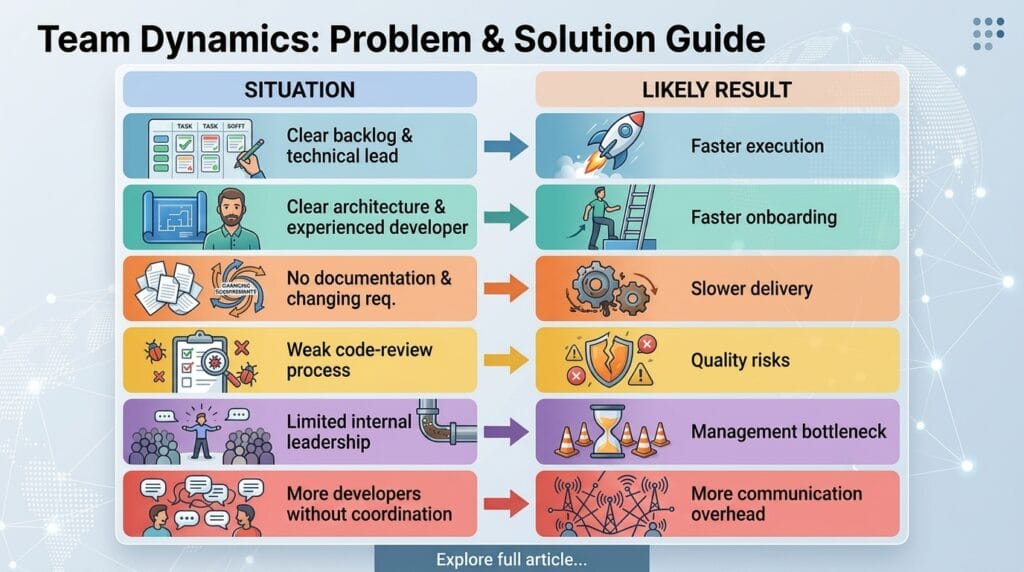
This is why simply measuring the number of developers added can be misleading.
The better measurement is whether the additional capacity produces reliable, reviewable, maintainable software.
Staff Augmentation vs. Dedicated Development Teams
The two models solve related but different problems.
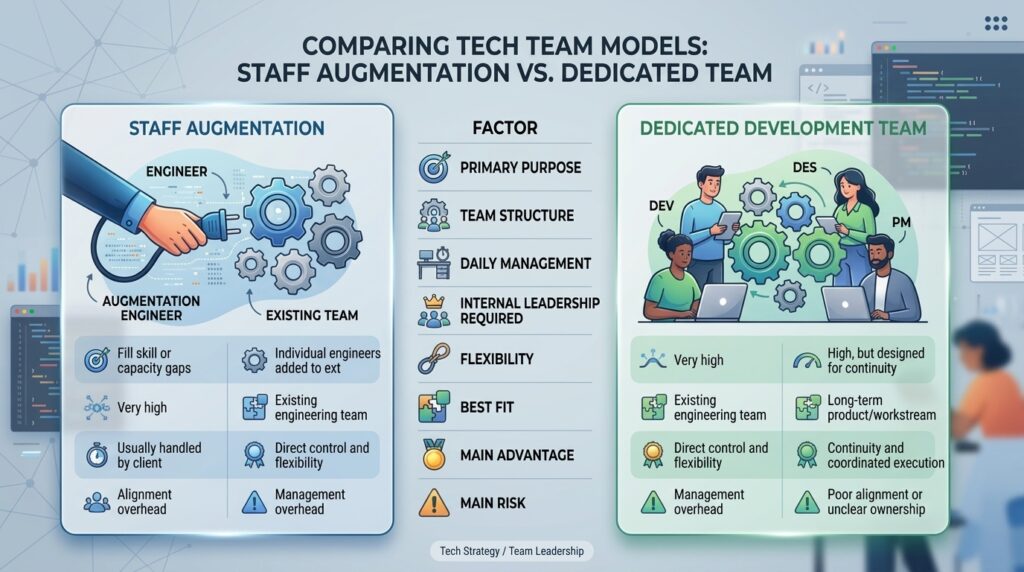
Staff augmentation is generally stronger when you already know what needs to be built and have the technical leadership to manage execution.
A dedicated development team becomes more attractive when the challenge extends beyond individual capacity—particularly when a product requires multiple engineering disciplines working together over time. Current industry comparisons similarly distinguish augmentation as an embedded capacity model and dedicated teams as a more stable ownership-oriented model.
Three Situations Where the Decision Changes
Scenario 1: You Need One Specialist
Your existing team has strong technical leadership, but you need a specific skill—for example, a DevOps engineer for a cloud migration.
Staff augmentation is likely the better fit.
You already have the management structure. You simply need additional expertise.
Scenario 2: Your Product Has Outgrown the Team
You now need frontend, backend, QA, DevOps, and technical leadership capacity for an ongoing product roadmap.
Adding individuals one by one may increase capacity, but it also increases coordination requirements.
A dedicated team may provide a better structure.
Scenario 3: Your CTO Is Already Overloaded
This is where companies often make the wrong decision.
If your CTO or engineering manager is already spending too much time assigning tasks, reviewing code, resolving dependencies, and managing delivery, adding more individual engineers may increase rather than reduce their workload.
The problem is no longer simply “we need more developers.”
It is “we need more delivery capacity with less coordination overhead.”
That is where a dedicated development team can become strategically useful.
Common Mistakes With Staff Augmentation
1. Hiring for headcount instead of a specific gap
Adding developers without identifying the bottleneck can create unnecessary coordination.
Better approach: Define the exact capability or capacity gap first.
2. Assuming an external developer needs no onboarding
Every engineer needs product and technical context.
Better approach: Prepare documentation, repository access, development standards, and a clear onboarding process.
3. Ignoring code-review capacity
More developers can produce more pull requests than your senior engineers can review.
Better approach: Establish review ownership before increasing team size.
4. Using augmentation to solve leadership problems
If architecture, priorities, and requirements are unclear, another developer will not automatically solve the problem.
Better approach: Fix decision-making and technical ownership first.
5. Measuring only development speed
A faster sprint is not necessarily a better sprint if it produces more bugs, rework, or technical debt.
Better approach: Track delivery alongside quality indicators such as defects, rework, review quality, and release stability.
How to Protect Quality While Scaling Engineering
A successful augmentation strategy needs more than good developers.
Start with clear ownership.
Every engineer should know:
- Who defines priorities
- Who approves technical decisions
- Who reviews code
- Who owns QA
- How requirements are documented
- How issues are escalated
- What “done” means
Next, establish a consistent workflow.
A practical process can look like:
Requirements → Sprint Planning → Development → Code Review → QA → Release → Monitoring → Feedback
The goal is not to create unnecessary process. It is to make expectations predictable.
Quality also improves when external engineers are integrated into the actual engineering environment rather than treated as disconnected resources. Using the same repositories, communication channels, issue-tracking system, review standards, and release process reduces unnecessary friction.
When Should You Use Staff Augmentation vs. Hire a Dedicated Team?
Use staff augmentation when:
- You already have strong engineering leadership.
- You need one or several specific skills.
- Your architecture and development processes are established.
- The capacity requirement may change.
- Your internal team can manage the additional engineers effectively.
Consider a dedicated software development team when:
- You have a long-term product roadmap.
- Multiple technical roles are required.
- A complete product area needs sustained attention.
- Internal management capacity is limited.
- Continuity and accumulated product knowledge matter.
- You need a coordinated team rather than individual contributors.
Neither model is universally better. The right choice depends on the bottleneck your business is actually trying to remove.
Where Dedicated Software Development Teams Fit
The biggest mistake is treating staff augmentation and dedicated development teams as competing versions of the same service.
They can actually represent different stages of engineering growth.
A company may start with staff augmentation to fill a temporary skill gap. As the product grows, the company may need a stable team covering development, QA, DevOps, and technical leadership.
At that point, continuing to manage every individual resource separately may become inefficient.
A dedicated software development team provides a way to build a more stable engineering structure around the product. Instead of focusing only on adding individual seats, the engagement can be designed around the capabilities required to continuously develop and maintain the product.
For companies evaluating external engineering support, the important question is therefore not simply how many developers can be added. It is what level of ownership, coordination, expertise, and continuity the roadmap requires.
Choosing the Right Engineering Model
Before selecting an engagement model, ask five questions:
- Do we have enough internal technical leadership?
- Is our problem a temporary skill gap or an ongoing delivery requirement?
- Can our existing team absorb and manage additional engineers?
- Does the product require multiple technical disciplines working together?
- Will additional capacity reduce our bottleneck—or create more coordination work?
If the answers point toward a focused skill or short-term capacity gap, staff augmentation may be the most efficient option.
If the answers point toward long-term product development and coordinated execution, a dedicated development team may provide a stronger foundation.
How NextPak Can Support Engineering Capacity
For organizations that need to expand engineering capacity without immediately building a larger internal organization, NextPak can support different development requirements through dedicated software development teams and related engineering services.
The appropriate model should depend on the product roadmap, internal capabilities, required technology expertise, and level of delivery ownership needed.
A strong engagement should begin with understanding those requirements—not simply assigning developers.
For companies considering the move from individual staff augmentation to a more structured engineering model, the first step is to identify whether the current bottleneck is talent, capacity, technical expertise, or coordination.
Once that is clear, the right team structure becomes much easier to evaluate.
FAQ
Is staff augmentation good for software engineering?
Yes, particularly when an established engineering team needs additional capacity or specialized expertise while retaining direct management and technical control.
Does staff augmentation improve development speed?
It can, but only when the existing team has sufficient leadership, clear requirements, and processes to integrate additional engineers efficiently.
Can staff augmentation reduce software quality?
It can introduce quality risks when onboarding, code reviews, architecture, testing, or technical ownership are weak. The model itself does not determine quality; execution does.
What is the difference between staff augmentation and a dedicated development team?
Staff augmentation generally adds individual engineers to an existing team. A dedicated development team provides a more stable, coordinated group designed around longer-term product development.
When should a company move from staff augmentation to a dedicated team?
When the organization needs multiple roles, sustained product ownership, greater continuity, or reduced day-to-day coordination with individual external resources.
Is a dedicated development team always better?
No. Staff augmentation can be more appropriate for focused skill gaps and temporary capacity needs. The right model depends on the company’s engineering structure and roadmap.
CTA: Get in touch with Nextpak.org team to explore the right development model for your roadmap, technology stack, and growth plans.