
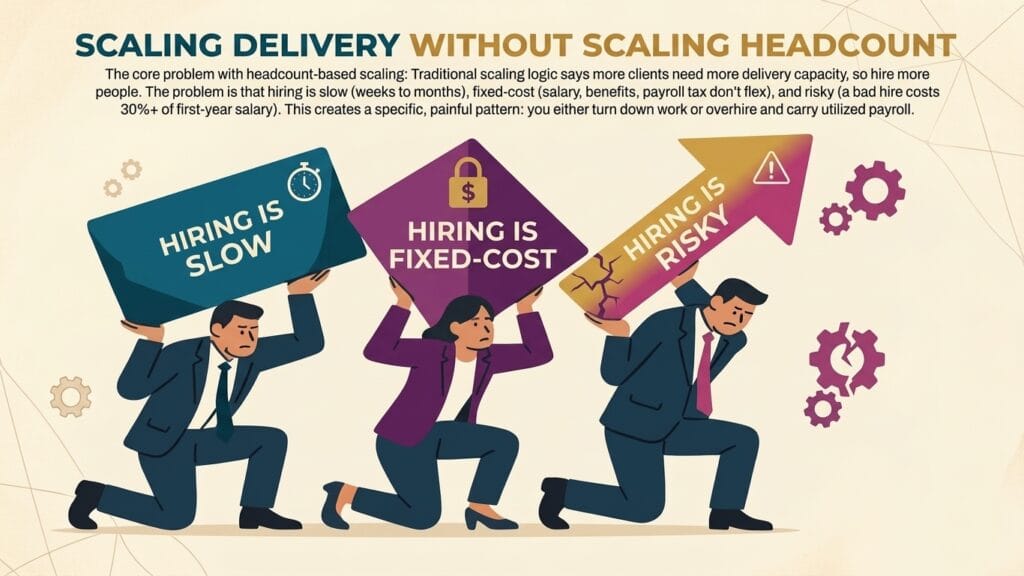
The core problem with headcount-based scaling
Traditional scaling logic says: more clients need more delivery capacity, so hire more people. The problem is that hiring is slow (weeks to months), fixed-cost (salary, benefits, and payroll tax don’t flex down in a slow quarter), and risky (a bad hire costs 30%+ of first-year salary once you count the redo and re-recruiting).
This creates a specific, painful pattern for growing agencies: you either turn down new client work because you’re not confident you can staff it, or you overhire in anticipation of demand that doesn’t materialize on schedule, and end up carrying payroll you can’t fully utilize.
What decoupling delivery capacity from headcount actually looks like
A Dev Pod model breaks that link. Instead of hiring a developer as a permanent fixed cost, you add dedicated capacity scoped to actual client demand — scaling a pod up when you land new business, scaling it down (or reallocating a developer to a different client) when a project wraps, without a layoff conversation or unused payroll sitting on your books.
This isn’t the same as project-based outsourcing, which sacrifices control and consistency. A Dev Pod developer is still dedicated, still embedded in your process, still working your timezone overlap — the flexibility is in the commitment length and scale, not in the quality of integration.
How this plays out across a growth curve
Early stage (occasional dev requests): One dedicated developer, brought on for a specific client project, gives you the ability to say yes to the requests you’d otherwise decline or refer out. You’re not committing to permanent headcount for demand you’re not sure is recurring yet.
Growth stage (dev work becoming a real, recurring revenue line): Expand to a small pod — a senior full-stack developer plus a QA engineer, for instance — matched to the actual mix of work coming in. You’re scaling in step with proven demand, not ahead of it.
Mature stage (dev is a core service line): At this point, some agencies do bring core roles in-house for the most strategic, long-term client relationships, while keeping a flexible Dev Pod layer for overflow, specialized skills (AI integration, mobile, niche stack needs), and new client onboarding where demand isn’t proven yet. The Dev Pod becomes a permanent flexibility layer even after in-house hiring starts.
The client-facing side of this
None of this needs to be visible to clients, and mostly shouldn’t be. From the client’s perspective, they hired your agency, and your agency delivered — reliably, on the timeline promised, with consistent communication through their existing point of contact. Whether the developer sits in your office or works from Lahore inside your Slack workspace is an internal staffing decision, not something that needs to enter the client conversation, provided the communication and quality bar stays consistent (which is exactly what timezone overlap and embedded process are designed to protect).
What this actually does to your unit economics
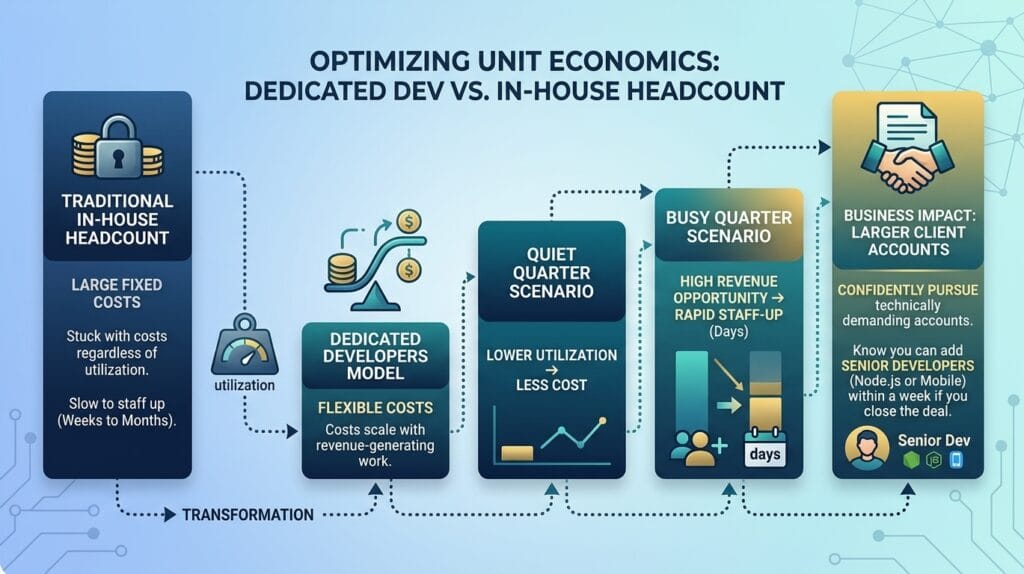
Scaling delivery through dedicated developers instead of in-house headcount changes the shape of your cost structure: instead of large fixed costs that you’re stuck with regardless of utilization, you get costs that scale much more closely with actual revenue-generating work. A quiet quarter costs you less. A busy quarter, you can staff up in days rather than months.
This also changes what kinds of clients you can confidently pursue. Bigger, more technically demanding accounts — the ones that used to feel risky to chase because you weren’t sure you could staff the delivery — become viable, because you know you can add a Senior Node.js Developer or a Senior Mobile Developer within a week if you close the deal, rather than needing to have already hired ahead of the sale.
The real shift this represents
The agencies that scale most efficiently over the next few years won’t be the ones with the biggest in-house engineering departments — they’ll be the ones with the most reliable access to flexible, high-quality delivery capacity, deployed against real demand as it appears. That’s a fundamentally different (and lower-risk) growth model than the traditional hire-ahead-of-demand approach, and it’s increasingly how growing agencies in the US, UK, EU, and Australia are actually structuring their delivery in 2026.
Where to start if this is new to you
You don’t need a five-year plan to test this. Pick the client request you’re most likely to get again — a Shopify build, a mobile app, an AI feature — and staff it with one dedicated developer on a trial basis. See how it performs inside your actual delivery process before deciding whether this becomes a standing part of how your agency scales.
CTA: Book a 15-minute call and we’ll show you 2-3 developer profiles so you can start scaling delivery on your next client project without adding fixed headcount. Full details at nextpak.org/agencies.