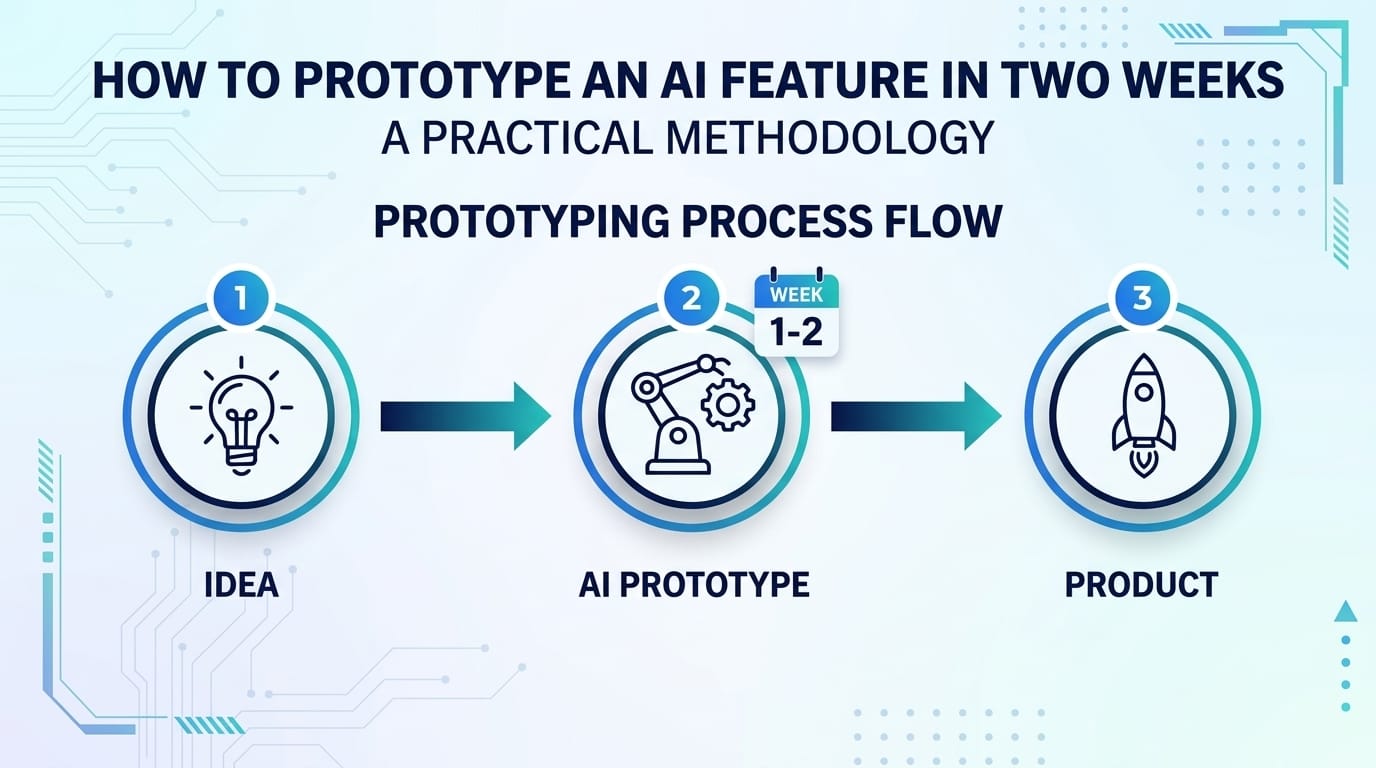
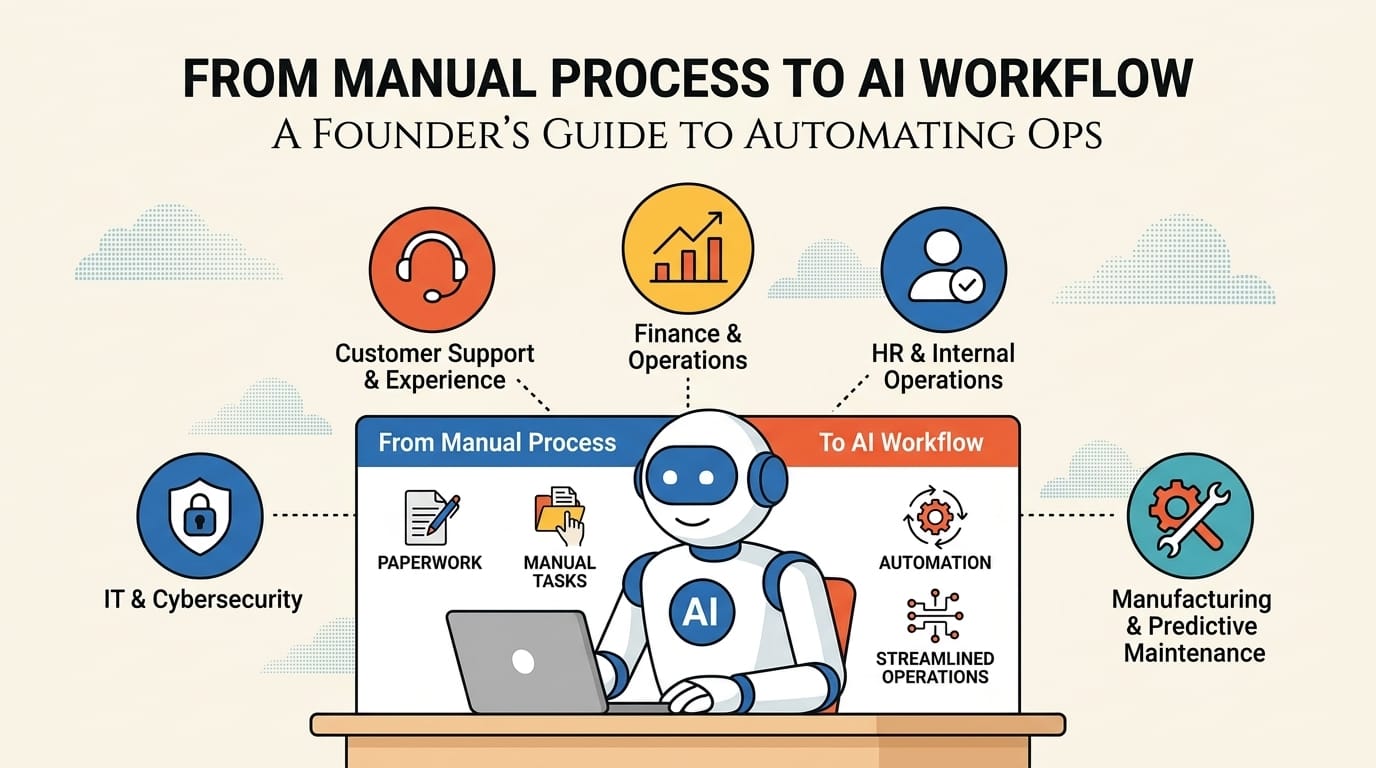
Your employees may already be using AI to write content, analyze information, generate code, and automate routine tasks. But individual productivity does not automatically translate into business-wide results. Without clear guidelines, suitable tools, practical training, and technical integration, AI initiatives can remain disconnected experiments rather than dependable business capabilities.
Enterprise AI adoption requires more than introducing another software platform. It involves preparing employees, identifying valuable use cases, managing risks, and redesigning workflows around measurable outcomes.
For CTOs, founders, and product managers, corporate AI bootcamp training can help teams build practical AI skills. The next step is determining where those skills can improve operations, support customers, or strengthen software products—and what technical capabilities are required to make those improvements sustainable.
What Enterprise AI Adoption Really Means
Enterprise AI adoption is the process of integrating artificial intelligence into an organization’s workflows, decisions, products, and operating model. It includes employee readiness, technical infrastructure, governance, and ongoing performance evaluation.
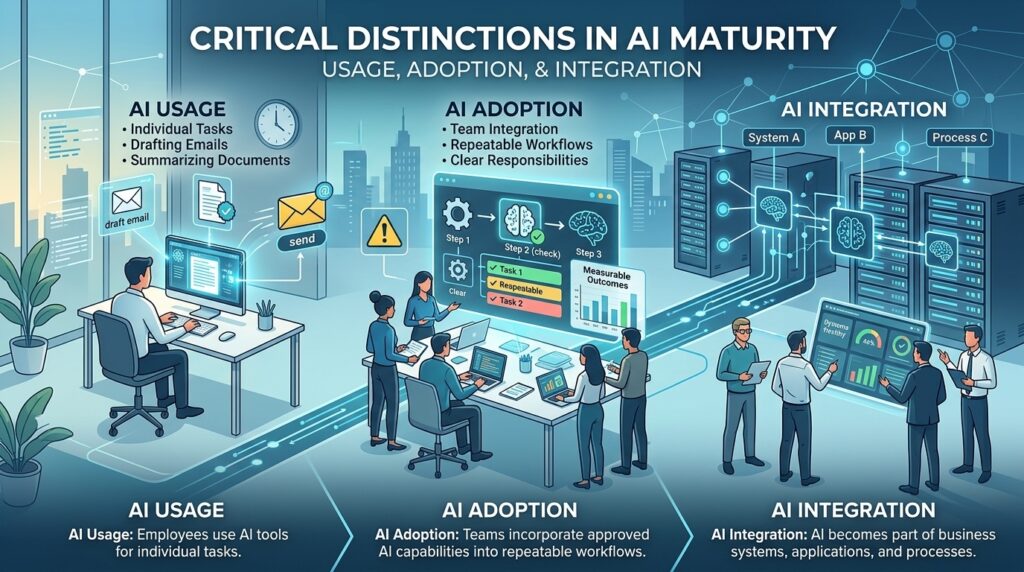
For example, an employee might use AI to summarize customer feedback manually. A more mature implementation could connect an AI-powered analysis feature to an approved feedback database, categorize recurring issues, and send findings to the relevant product team for review.
The second approach requires more than prompting skills. It needs data access controls, application integration, testing, and a defined process for handling inaccurate outputs.
Why Corporate AI Bootcamp Training Matters
Corporate AI bootcamp training gives employees structured opportunities to learn how AI works, where it is useful, and how to apply it to real work. Unlike generic demonstrations, effective training should reflect participants’ roles, responsibilities, and business challenges.
A practical program can cover four areas:
1. AI fundamentals and limitations
Employees learn how generative AI produces outputs, why responses can be inaccurate, and when human verification is necessary.
2. Role-specific applications
Marketing teams might practice research and content workflows, analysts might explore data summarization, and developers might use AI for code assistance, documentation, and test generation.
3. Responsible and secure usage
Training should explain which information employees may enter into approved tools, how to protect confidential data, and when outputs require additional review.
4. Workflow improvement
Participants identify repetitive tasks, map the existing process, test an AI-assisted alternative, and compare the results against a baseline.
Microsoft’s 2024 Work Trend Index highlighted a gap between workplace AI use and formal company training: its research reported that 75% of surveyed knowledge workers used AI at work, while only 39% of surveyed AI users had received AI training from their employer. These figures describe that specific 2024 survey, not every organization today. They illustrate why access to tools alone does not guarantee organizational readiness. Source: Microsoft Work Trend Index.
A Practical Framework for Enterprise AI Adoption
A successful initiative should progress from a business problem to a controlled, measurable implementation.
Step 1: Identify business problems before selecting tools
Start by identifying friction in existing workflows. Look for repetitive manual work, slow information retrieval, document-heavy processes, recurring support requests, or delays caused by fragmented data.
Rank potential use cases by business value, feasibility, risk, and implementation effort. Avoid adopting a tool simply because it is popular.
Step 2: Assess employee readiness and deliver training
Determine employees’ current skill levels, existing AI usage, and concerns about accuracy, privacy, or job responsibilities.
Use corporate AI bootcamp training to develop practical skills around the selected use cases. Give employees exercises based on realistic tasks, along with clear guidance on approved tools and acceptable usage.
Step 3: Establish governance and data controls
Before expanding access, define ownership, permitted use cases, data classifications, human review requirements, and escalation procedures.
The National Institute of Standards and Technology’s AI Risk Management Framework and its Generative AI Profile provide useful references for identifying and managing AI risks across the lifecycle. Organizations should adapt their controls to their own operating environment and applicable legal obligations. Source: NIST Generative AI Profile.
Step 4: Run a focused pilot
Choose one use case with a clear objective, a manageable scope, and a way to measure performance.
For example, a company could test AI-assisted internal document search with a limited group of employees. Measure whether users find relevant information faster, whether answers are accurate, and whether access controls prevent unauthorized information exposure.
Step 5: Integrate and test the solution
If the pilot requires AI to interact with company data or applications, assess the necessary engineering work. This may include APIs, authentication, retrieval systems, workflow automation, logging, and user interface changes.
Test expected behavior, failure cases, security, and performance before moving into production.
Step 6: Measure, refine, and scale
Compare actual results with the original baseline. Track relevant measures such as time saved, error rates, adoption, operating costs, and user satisfaction.
Expand only when the pilot demonstrates sufficient value and the team can support the solution reliably.
Common AI Adoption Mistakes and How to Avoid Them
1. Treating training as the entire strategy. Employees may learn useful techniques but lack suitable workflows or approved tools. Connect training exercises to business priorities and implementation plans.
2. Choosing tools before defining the problem. This can produce expensive experiments with little operational value. Define the desired outcome first, then evaluate suitable options.
3. Ignoring data privacy and security. Employees may expose confidential information through unapproved tools. Establish approved usage rules, access controls, and data-handling procedures.
4. Automating an inefficient process. AI can make a poor workflow faster without making it better. Simplify the process and define responsibilities before automating it.
5. Skipping evaluation. A convincing demonstration does not prove that a system is reliable. Test outputs against representative examples, define acceptance criteria, and monitor performance after launch.
6. Scaling too early. A successful pilot may depend on manual checks or limited data that will not be available at scale. Validate integration, operating costs, security, and support requirements before wider deployment.
When Does a Business Need an AI Engineering Team?
Training and engineering solve different problems. The appropriate investment depends on what the organization is trying to accomplish.
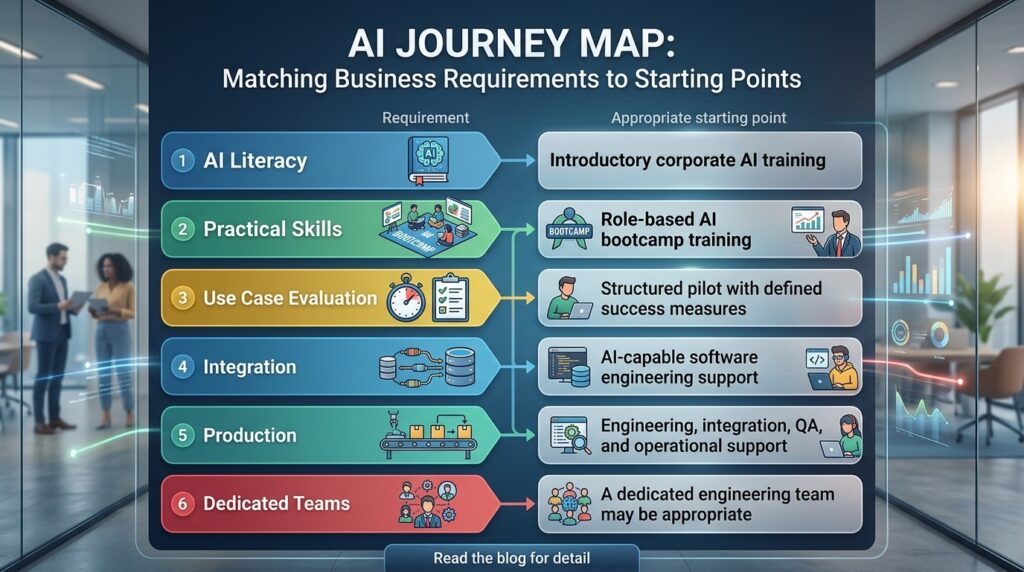
Consider two hypothetical scenarios.
Scenario A: A professional services firm wants employees to draft first versions of internal reports more efficiently. Approved tools, practical training, and review guidelines may be enough to begin.
Scenario B: A growing software company wants to add an AI assistant to its customer portal, retrieve information from authorized company data, and integrate with existing account systems. This requires architecture, application development, permissions, evaluation, testing, and ongoing maintenance.
The second scenario calls for engineering capacity beyond training alone. A dedicated team may be useful when the organization needs sustained development but does not want to build every required capability through permanent hiring.
How Dedicated Software Development Teams Support AI Adoption
The challenge is often not learning what AI can do; it is turning a promising use case into a secure, maintainable solution that works within existing business systems.
A dedicated software development team can support this transition by providing ongoing engineering capacity for architecture, application development, API integration, quality assurance, deployment, and maintenance. Depending on the project, the team may also need AI or machine-learning expertise, data engineering, and security specialists.
Before engaging a provider, assess whether it can:
- Translate business goals into clear technical requirements.
- Explain architecture choices, integration dependencies, and trade-offs.
- Build appropriate authentication, access controls, and data-handling safeguards.
- Evaluate AI outputs and test failure scenarios, not just successful demonstrations.
- Document the solution and support monitoring, maintenance, and future improvements.
At NextPak, dedicated software development teams are the relevant service to explore when AI adoption creates a sustained need for software engineering capacity. The engagement should be shaped around your roadmap, existing team, and technical requirements—not around AI adoption as a trend.
If your organization is still deciding which use cases to pursue, begin with a readiness assessment and a small, measurable pilot. If the use case is validated but your team lacks the capacity to implement it, evaluate whether dedicated engineering support is the right next step.
Frequently Asked Questions
What is enterprise AI adoption?
Enterprise AI adoption is the structured integration of AI into business workflows, products, and operations, supported by employee skills, governance, technical infrastructure, and performance measurement.
What is corporate AI bootcamp training?
Corporate AI bootcamp training is a structured learning program that helps employees develop practical AI skills through guided exercises, role-specific use cases, and responsible-use practices.
How long does enterprise AI adoption take?
The timeline depends on the use case, data readiness, security requirements, integration complexity, and employee readiness. A small training initiative or pilot may be completed sooner than a production system requiring multiple integrations. Define milestones before committing to a timeline.
How can a company measure AI adoption success?
Measure outcomes relevant to the use case, such as task completion time, error rates, output quality, employee adoption, customer experience, and total operating cost. Compare results with a baseline rather than relying only on usage counts.
Is AI training enough to implement AI across a business?
Training builds skills and awareness, but production adoption may also require data preparation, system integration, governance, testing, and monitoring. The necessary combination depends on the intended application.
When should a company hire a dedicated software development team?
Consider a dedicated team when validated business requirements demand ongoing engineering capacity, specialized technical skills, or integration work that the existing team cannot sustainably support.
Turn AI Readiness Into Practical Implementation
Enterprise AI adoption works best when employee capability, responsible governance, and technical execution move together. Corporate AI bootcamp training can prepare people to use AI effectively; careful evaluation and engineering can help turn suitable opportunities into dependable business solutions.
If your organization has identified an AI opportunity but lacks the capacity to build and integrate it, explore NextPak’s dedicated software development teams as a potential way to extend your engineering capabilities. Start by clarifying the business outcome, technical requirements, and skills your project needs before selecting an engagement model.
Ready to Turn Your AI Ideas Into Working Solutions?
AI training can help your employees identify new opportunities, but implementing those opportunities may require software development, system integration, testing, and ongoing technical support.
NextPak’s Dedicated Software Development Teams can help businesses explore the engineering capacity needed to connect AI initiatives with existing systems and turn validated requirements into practical software solutions.
Have an AI use case ready to implement? Discuss your technical requirements and development goals with NextPak to explore the right team structure for your project.
Explore Dedicated Development Teams
CTA: Book a 15-minute call and we’ll show you 2-3 matching developer profiles — no commitment, just options. Check out nextpak.org to see how the model works end to end.