
Where AI is genuinely working in healthtech today
Clinical documentation and ambient scribing. LLM-based tools that listen to (or transcribe) a clinical encounter and generate structured notes are mature enough for production use, and this is one of the fastest-growing categories in healthtech AI for good reason — documentation burden is a real, measurable pain point, and the AI’s job (summarize what was said) is well-matched to what LLMs do well. The key architectural requirement is a mandatory human review step before any note enters the medical record — no healthtech company should ship auto-finalized clinical notes without clinician sign-off.
Administrative and operational automation. Prior authorization paperwork, claims processing, scheduling, and intake form processing are strong AI automation targets because they’re high-volume, rules-heavy, and don’t involve direct clinical judgment. This is squarely in AI document processing territory — OCR plus structured extraction plus validation — and it’s some of the highest-ROI healthtech automation available right now.
Patient-facing triage and information (non-diagnostic). AI chat that helps patients navigate “which department do I need,” answers questions about scheduling, insurance, or general health information from vetted sources, and collects structured intake information before a visit is working well in production, as long as it’s clearly scoped to not provide diagnosis or treatment recommendations.
Clinical decision support (assistive, not autonomous). Tools that surface relevant literature, flag a potential drug interaction for a clinician to review, or summarize a patient’s history for a provider about to see them are valuable and increasingly production-ready — the load-bearing design choice is that a licensed clinician remains the decision-maker, with AI in a supporting, evidence-surfacing role.
Skills and workforce readiness platforms. Outside direct clinical care, AI-driven platforms that assess healthcare worker skills, match training to competency gaps, and support career readiness are a strong fit for LLM-based assessment and recommendation systems — this pattern (combining structured assessment with AI-driven guidance) is close to workforce development work we’ve shipped in other verticals.
Where healthtech AI is not there yet

Autonomous diagnosis. LLMs generating a diagnosis without clinician review is not where the regulatory environment, liability landscape, or honestly the technology’s reliability is in 2026. Even well-performing models make confident, wrong claims often enough that autonomous diagnostic use is both a patient safety risk and, in most jurisdictions, a regulatory non-starter without FDA clearance as a medical device — a completely different and much longer process than a typical software build.
Fully autonomous treatment recommendations. Similar to diagnosis — AI can surface options and relevant guidelines, but autonomous treatment decisions without clinician oversight are not a responsible or currently legal deployment pattern for LLM-based systems in most contexts.
High-stakes decisions with no audit trail. Same principle as fintech — if a decision affecting patient care can’t be explained after the fact with a clear chain from source data to recommendation, it’s not ready for production in a compliance-sensitive healthtech product.
Fully unsupervised patient-facing diagnostic chat. Symptom-checker-style AI chat that edges into diagnostic territory without clear guardrails and disclaimers is both a liability risk and, depending on framing, potentially a regulated medical device in some jurisdictions. This is a case where legal and product need to be in the room during architecture design, not after.
The architecture pattern that works across all of this
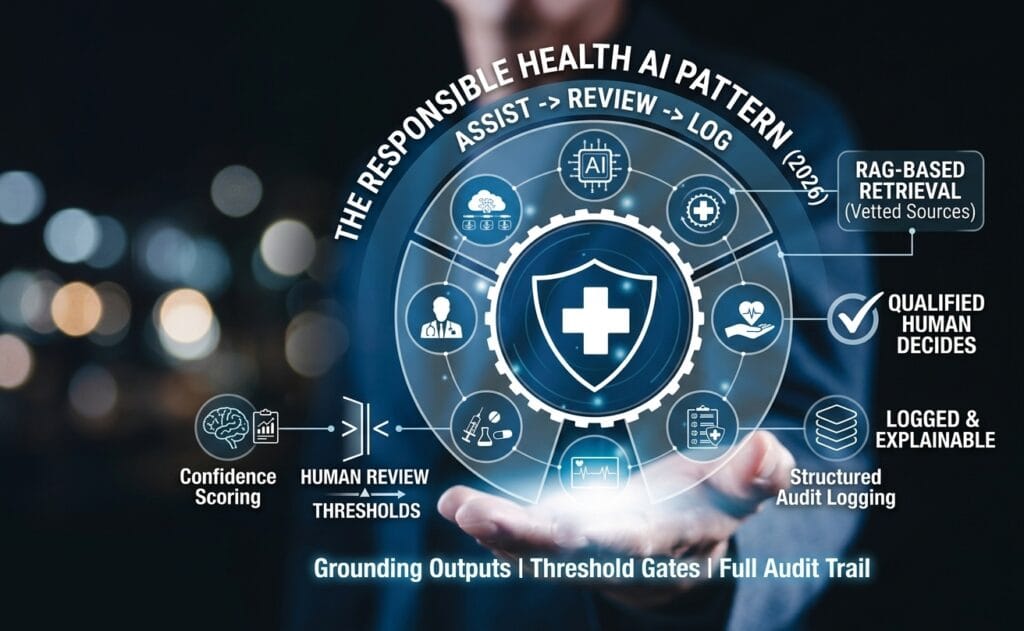
The common thread in every production-ready healthtech AI use case above: AI assists, a qualified human decides, and every step is logged and explainable. This isn’t a limitation to work around — it’s the actual shape of a responsible, deployable healthtech AI system in 2026, and building it this way from the start is faster than building an autonomous system and getting forced to retrofit human review after a compliance or safety review.
Technically, this usually means RAG-based retrieval (grounding outputs in vetted sources, not model memory), confidence scoring with human review thresholds, structured audit logging, and a clear UI distinction between “AI-generated, unreviewed” and “clinician-confirmed” content.
What this means for your roadmap
If you’re a healthtech founder scoping your AI roadmap, prioritize the administrative and documentation automation first — it’s lower regulatory risk, faster to ship, and delivers real ROI quickly. Treat anything touching diagnosis or treatment as a longer-horizon investment requiring closer legal and clinical involvement in the architecture, not a fast follow.
CTA: If you’re mapping out which parts of your healthtech product are ready for AI automation now versus later, let’s scope it together — nextpak.org, short call. NextPak has been building production AI systems since 2020.