A startup can have a strong product vision, growing customer demand, and a clear roadmap yet still struggle to ship features on time. The problem is often not a lack of ideas. It is limited engineering capacity, competing priorities, and the coordination required to turn product requirements into reliable software.
Hiring individual developers can help, but it does not automatically create a team that can deliver independently. Founders and CTOs need the right combination of technical skills, ownership, communication, and delivery processes.
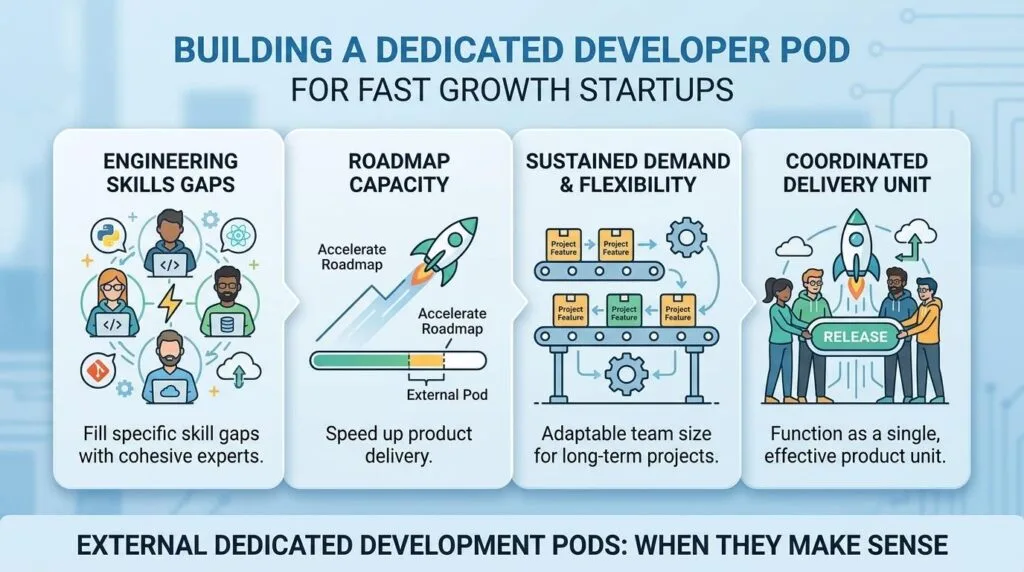
Building a dedicated developer pod for a startup means creating a focused engineering team around a product, feature set, or business objective. When structured correctly, a pod helps startups increase development capacity, establish clearer accountability, and adapt as their products evolve.
This guide explains how to structure a developer pod, choose the right engagement model, avoid common mistakes, and determine whether a dedicated development team is the right next step.
What Is a Dedicated Developer Pod?
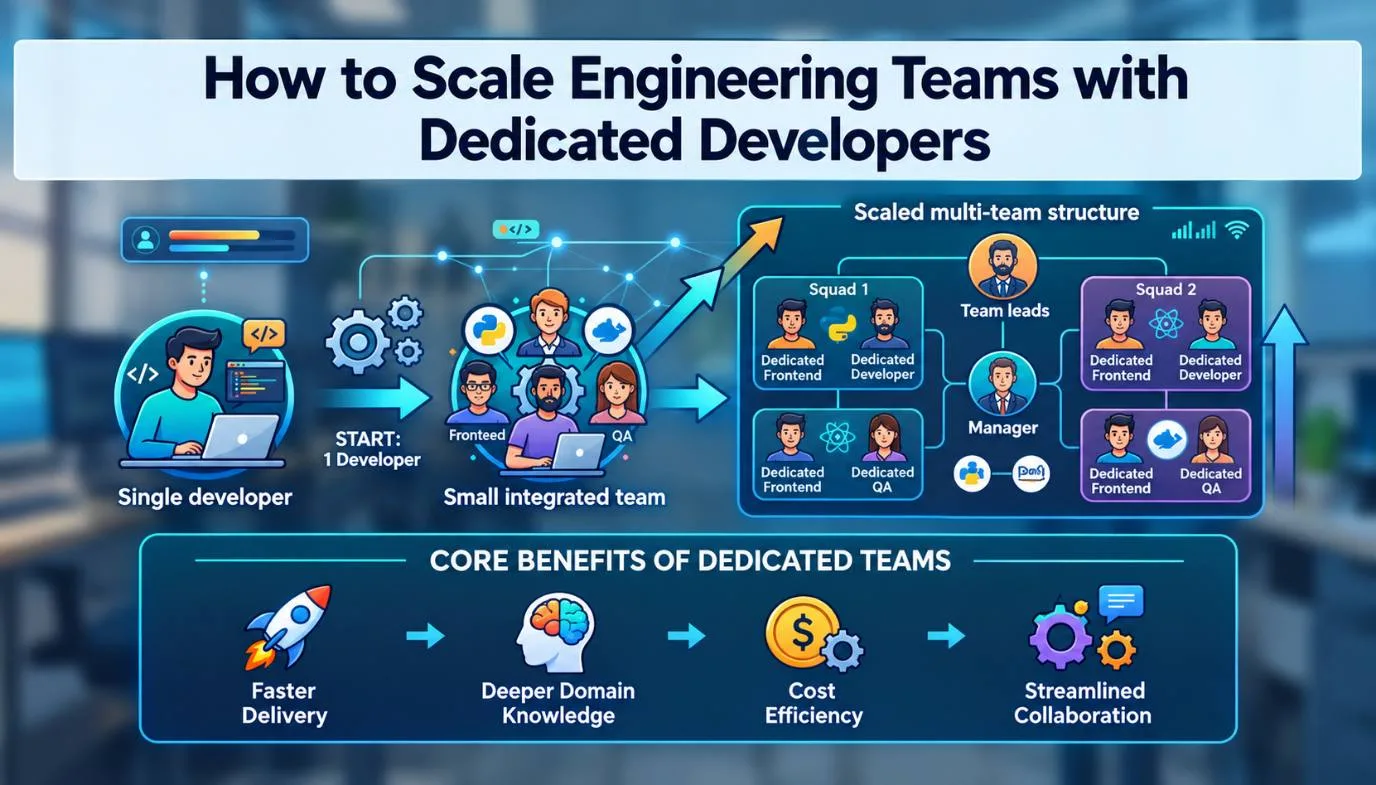
A dedicated developer pod is a small, cross-functional software development team assigned to a defined product area or set of business goals. Rather than treating every developer as a separate resource, the pod works as a coordinated unit with shared priorities and delivery responsibilities.
Depending on the project, a pod may include:
- Frontend developer: Builds user interfaces and customer-facing functionality.
- Backend developer: Develops APIs, business logic, databases, and server-side systems.
- QA engineer: Tests functionality, identifies defects, and supports release quality.
- Tech lead: Guides architecture, reviews technical decisions, and maintains engineering standards.
- Product manager or designer: Clarifies requirements, prioritizes features, and shapes user experience when needed.
Not every startup needs all these roles full-time. A smaller product may begin with two or three engineers and shared QA or technical leadership. More complex products may require dedicated specialists, DevOps support, or additional developers.
The defining feature is not team size. It is clear ownership, complementary skills, and a shared delivery objective.
Why Fast-Growth Startups Need Developer Pods
Growth creates engineering pressure in several ways.
First, product requirements expand. Early customers request integrations, improved workflows, reporting features, and usability improvements. Second, the existing team must balance new development with bug fixes, infrastructure, and technical debt. Third, every additional developer introduces coordination needs around code reviews, architecture, documentation, and releases.
Without a deliberate structure, more people can mean more handoffs rather than faster delivery.
A dedicated pod helps address these challenges by establishing a consistent group that understands the product area it owns. The team can build context over time, collaborate on technical decisions, and plan work around shared priorities.
Consider a startup preparing to launch a customer dashboard. Its existing engineers are already maintaining authentication, payment processing, and production systems. Assigning the dashboard to a dedicated pod creates focused development capacity without continually shifting the core team away from essential maintenance.
However, a pod is not an automatic productivity fix. It still needs realistic priorities, access to decision-makers, clear acceptance criteria, and a reliable release process.
How to Structure a Developer Pod for Your Startup
The right composition depends on product complexity, delivery expectations, and the capabilities of your current team.
1. Start with the product outcome
Define what the pod is expected to deliver before deciding how many developers to hire.
For example, the objective might be to launch an MVP, rebuild a slow checkout process, develop a mobile application, or integrate a third-party platform. Each objective requires a different skill mix.
Translate the goal into a manageable backlog, technical requirements, dependencies, and measurable acceptance criteria. This gives the pod a clear starting point and helps prevent scope from expanding without agreement.
2. Choose roles based on actual workload
A startup building a relatively simple web application may need a full-stack developer, another engineer, and access to QA support. A product with complex APIs, multiple integrations, and demanding reliability requirements may need separate frontend and backend expertise, dedicated QA, and technical leadership.
Avoid copying another company's team structure. Instead, identify which capabilities are essential, which can be shared, and which can be added as the product grows.
3. Establish ownership and decision-making
Every pod should know who prioritizes the backlog, who approves technical decisions, who reviews code, and who accepts completed work.
The startup usually retains control of product strategy and business priorities. The pod handles engineering execution within agreed boundaries, escalating decisions that affect scope, architecture, security, or delivery commitments.
This division reduces unnecessary approval cycles without removing the startup's control over its product.
Dedicated Developer Pod vs. Other Hiring Models
A developer pod is one option for expanding engineering capacity. The best model depends on how much ownership, coordination, and management support the startup needs.

A startup with strong technical leadership but a shortage of backend expertise may benefit from staff augmentation. A founder-led company without enough engineering management capacity may prefer a more coordinated pod with technical leadership and QA support.
A fixed-scope project can be appropriate when the requirements are stable and the deliverable is clearly defined. A dedicated pod is often more suitable when the product roadmap will evolve and development must continue across multiple releases.
The important distinction is whether you need additional people, a coordinated delivery unit, or a provider responsible for a defined project outcome.
How to Build and Manage a Dedicated Developer Pod
A practical setup process helps the team become productive without creating unnecessary management overhead.
Step 1: Define scope and success criteria
Identify the product area, expected deliverables, technical constraints, dependencies, and business priorities. Establish how progress will be evaluated.
Useful indicators may include lead time for changes, release frequency, escaped defects, sprint completion trends, and delivery against agreed milestones. Interpret these measures together rather than relying on a single metric.
Step 2: Assess your existing engineering environment
Review the current architecture, repository structure, development tools, deployment pipeline, security requirements, and documentation. Identify integration risks and knowledge gaps before new developers begin working.
Step 3: Select the team and engagement model
Choose the required skills, seniority, leadership, and QA coverage. Agree on responsibilities, working hours, communication channels, access permissions, and escalation procedures.
Step 4: Establish a delivery rhythm
Use a shared backlog, regular planning, code reviews, automated testing where appropriate, and sprint reviews or demonstrations. Keep meetings purposeful and document decisions that affect implementation.
Step 5: Measure, learn, and adjust
Review delivery quality and bottlenecks regularly. If features are delayed because requirements are unclear, adding developers may not solve the problem. If testing is consistently slowing releases, additional QA capacity or better automation may be more valuable.
The pod should evolve with the product instead of remaining fixed regardless of changing needs.
Common Mistakes When Building a Developer Pod
1. Hiring before defining the problem. Without a clear objective, teams can spend time on low-priority work. Define the desired outcome and backlog first.
2. Choosing team size based only on budget. A cheaper team may lack critical skills, while an oversized pod creates unnecessary coordination. Match capacity to workload and complexity.
3. Treating QA as an afterthought. Late testing can uncover expensive defects near release. Include quality practices throughout development.
4. Keeping requirements unclear. Developers cannot reliably estimate or implement constantly changing expectations without context. Document acceptance criteria and manage scope changes explicitly.
5. Measuring activity instead of outcomes. Hours worked and tickets closed do not automatically indicate customer value. Combine delivery metrics with quality and product outcomes.
6. Ignoring documentation and knowledge transfer. Undocumented architecture and decisions create dependency on specific individuals. Maintain useful technical documentation and review key decisions.
7. Outsourcing ownership along with execution. External developers can implement features, but the startup should retain visibility into priorities, product decisions, security, and intellectual property arrangements.
Should You Build Internally or Work with a Specialist?
Internal hiring can be the right choice when a startup has time to recruit, needs long-term in-house expertise, and can support the full employment and management process.
Before choosing a provider, assess technical experience, communication practices, QA processes, security controls, documentation standards, ownership of source code, and the terms for scaling or ending the engagement.
Clarify who manages technical decisions, how progress is reported, how team members can be replaced, and how knowledge is transferred. A well-defined engagement should make responsibilities and expectations easier to understand, not harder.
How NextPak's Dedicated Development Teams Fit
The underlying challenge is not simply finding more developers. It is creating the engineering capacity and coordination needed to move a product roadmap forward without losing control of quality or priorities.
NextPak's Dedicated Software Development Teams service is relevant for businesses evaluating a structured way to expand development capacity. When assessing this model, define the skills required, the product area the team will support, the expected working relationship, and the quality and communication practices needed for delivery.
Depending on your requirements, related approaches may also be worth considering. Staff augmentation can address specific capability gaps, while custom software development may be appropriate when the primary need is to deliver a defined solution. QA and testing can support release confidence, and full-stack development can help cover both frontend and backend work.
The right engagement should fit your actual bottleneck rather than forcing every problem into the same team structure.
Planning to expand your engineering capacity? Start by identifying your roadmap priorities, current delivery constraints, and the skills missing from your team. Then discuss the most appropriate team structure with NextPak through nextpak.org.
Frequently Asked Questions
What is a dedicated developer pod for startups?
It is a focused software development team that works toward shared product goals. Depending on the startup's needs, it may include frontend and backend developers, QA engineers, and technical leadership.
How many developers should a startup pod have?
There is no universal size. A small product initiative may begin with two or three engineers and shared support, while more complex products may require a larger cross-functional team. Base the decision on workload, dependencies, and required skills.
Is a developer pod better than staff augmentation?
A pod is useful when you need coordinated engineering capacity around a product objective. Staff augmentation is often more suitable when your existing team already manages delivery and only needs additional skills or capacity.
How long does it take to establish a dedicated developer pod?
The timeline depends on role availability, technical complexity, access requirements, onboarding, and how clearly the work is defined. Discovery and preparation can reduce delays after the team starts.
Can a dedicated developer pod work with an existing engineering team?
Yes. The teams need agreed ownership boundaries, shared development standards, access to relevant systems, and clear communication around dependencies and releases.
What should startups evaluate before hiring a development team?
Review technical skills, relevant experience, communication, QA, security practices, documentation, source-code ownership, pricing structure, and flexibility as requirements change.
How can a startup measure a pod's effectiveness?
Track delivery flow, release quality, defects, milestone progress, and outcomes relevant to the product. Use these indicators to identify bottlenecks rather than treating any single metric as a complete measure of performance.
Ready to Build a Dedicated Developer Pod for Your Startup?
As your startup grows, you need more than additional developers. You need the right combination of technical skills, clear ownership, and reliable delivery processes to turn your product roadmap into working software.
NextPak's Dedicated Software Development Teams can help you explore a team structure aligned with your product requirements, engineering gaps, and growth plans.
Whether you need frontend and backend expertise, QA support, or a coordinated team for ongoing development, start by identifying your priorities and the capabilities required to achieve them.
Planning your next stage of product growth? Discuss your engineering requirements with NextPak to explore the right development team structure for your startup.
Explore Dedicated Development Teams
CTA: Book a 15-minute call and we’ll show you 2-3 matching developer profiles — no commitment, just options. Check out nextpak.org to see how the model works end to end.