
What “AI agent” actually means, precisely
Loosely, an agent is an LLM system that can take multiple steps, use tools, and make decisions about what to do next based on intermediate results — as opposed to a single prompt-response call. That’s a spectrum, not a binary. On one end: a single LLM call with function-calling access to a couple of tools. On the other end: a fully autonomous multi-agent system that plans, executes, self-corrects, and operates for extended periods with minimal human oversight. Almost all the hype lives on the far end of that spectrum, and almost all the production reliability lives on the near end.
What’s actually production-ready in 2026
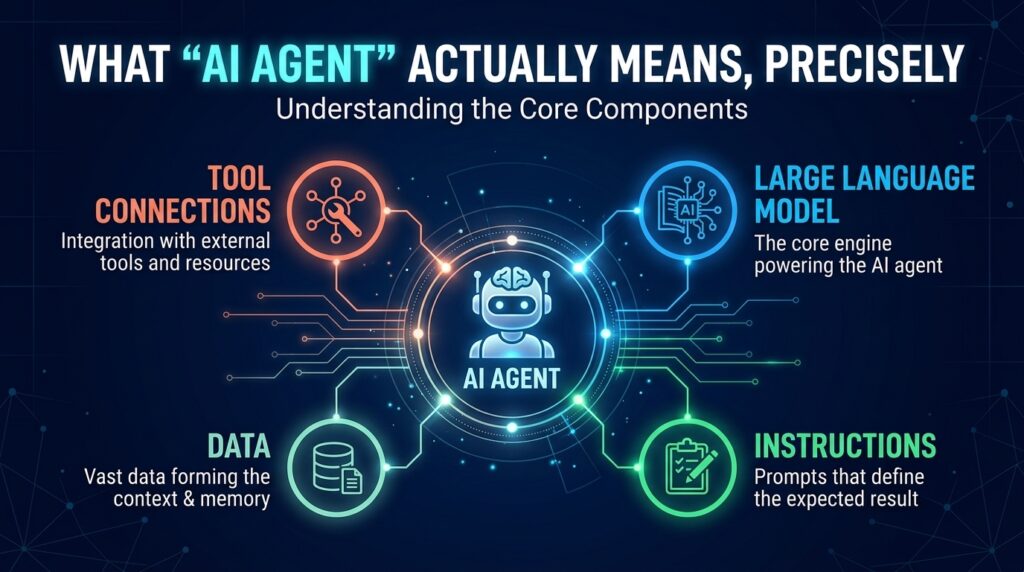
Single-agent tool use with a bounded action set. An LLM that can call a small, well-defined set of functions — look up a record, search a knowledge base, send an email through a template — and reasons about which to call based on user input, is solid and widely deployed in production. This is the backbone of most working support bots and internal tools today.
Multi-step workflows with deterministic structure. Agentic workflows where the steps are largely known in advance (extract data, validate it, then route to one of three downstream actions) but the LLM handles the judgment calls within each step, are reliable and shipping in production across document processing, support, and internal ops automation.
Retrieval-augmented research and summarization agents. Agents that search across multiple sources (internal docs, web search, a database) and synthesize a grounded answer are working well, particularly when each retrieval step is verifiable and the final output cites its sources rather than presenting a synthesized claim with no trail back to evidence.
Coding agents for well-scoped tasks. Tools like Claude Code and similar coding agents have become genuinely production-useful in 2026 for well-scoped engineering tasks — implementing a defined feature, fixing a specific bug, writing tests against clear requirements — especially with human review before merge. This is worth noting because it’s one of the clearest examples of agentic AI that has crossed from hype to daily-use tool.
What’s still not reliable enough for unattended production use
Fully autonomous long-horizon planning. Agents that plan and execute a complex, multi-day, many-step task with no human checkpoints still fail in ways that are hard to predict and expensive to debug — errors compound across steps, and a wrong assumption early in a long chain quietly corrupts everything downstream. This is improving, but “set it and forget it” autonomy over long horizons isn’t a bar most production systems should aim for yet.
Multi-agent systems with open-ended coordination. Architectures where multiple agents negotiate, delegate, and coordinate with each other with minimal structure look impressive in demos and are notoriously difficult to debug and keep reliable in production — failure modes multiply with each additional agent in the loop, and root-causing a bad outcome across several agent “conversations” is a real engineering headache.
High-stakes autonomous action with no human gate. Any agent with the ability to take a consequential, hard-to-reverse action (send money, delete data, send a customer-facing communication with legal weight) without a human checkpoint is a reliability and liability risk regardless of how good the underlying model has gotten. This isn’t a model-capability limitation anymore so much as a “you shouldn’t build it this way” judgment call.
Agents that need to handle truly novel situations gracefully. Current agents are good within the distribution of scenarios they’ve been designed and tested for. They degrade — sometimes silently, confidently — when they hit a genuinely novel edge case outside that design envelope. Production systems need explicit fallback and escalation paths for exactly this reason.
The architecture principle that separates working agent systems from failed ones
The production-ready agent systems all share a design principle: bound the action space, keep humans in the loop at consequential decision points, and build in explicit fallback paths for low-confidence or out-of-distribution situations. The failed agent projects we’ve seen all shared the opposite: unbounded tool access, no human checkpoints, and an assumption that the agent would “figure it out” in edge cases it was never actually tested against.
What this means for your roadmap
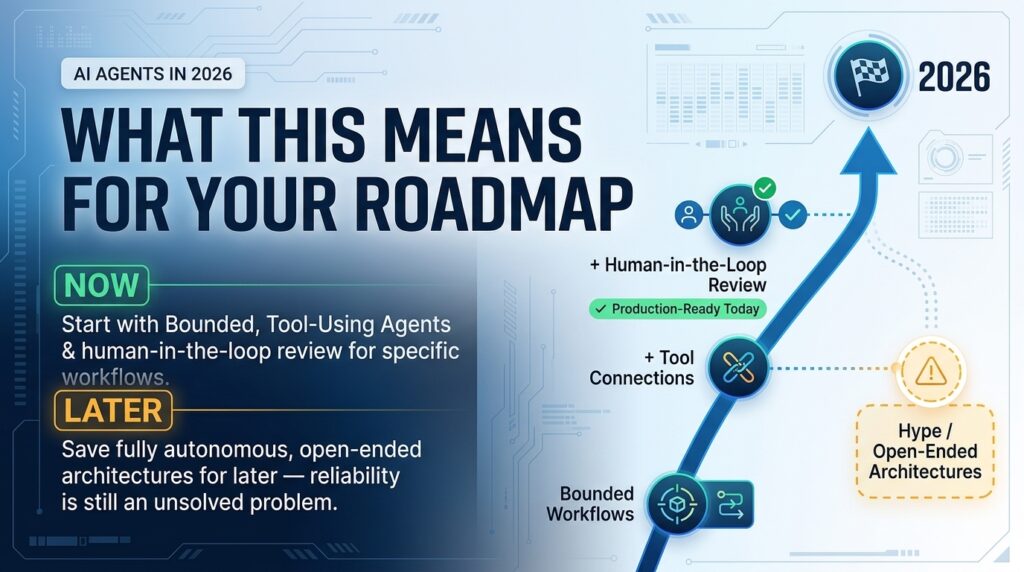
If you’re considering agentic AI for your product in 2026, start with bounded, tool-using agents solving a specific, well-defined workflow, with human review at the points that matter. That’s genuinely production-ready today and delivers real value. Save fully autonomous, open-ended agent architectures for later — not because the idea is bad, but because the reliability engineering to make them trustworthy in front of real customers is still an active, unsolved problem industry-wide, not something any vendor has fully cracked yet regardless of their marketing.
CTA: If you’re scoping an agentic AI feature and want an honest read on what’s reliable enough to ship versus what needs more guardrails, let’s talk it through — nextpak.org , short call. NextPak builds bounded, production-grade agent systems, not demos.