
The current landscape, briefly
On the closed-model side, OpenAI’s GPT-4o and GPT-4o-mini, Anthropic’s Claude, and Google’s Gemini 2.0/2.5 family are the dominant API-based options, each with slightly different strengths — Gemini’s long context and multimodal handling, Claude’s strength on complex reasoning and coding tasks, OpenAI’s broad ecosystem and tool support. On the open-source side, Llama (Meta), Mistral, Qwen, and DeepSeek’s model families have closed much of the quality gap with closed models, especially at the mid-size tier, and can be self-hosted or run through providers like Together AI, Fireworks, or Groq for speed.
The gap in raw quality between the best closed models and the best open-source models has narrowed significantly, but “narrowed” doesn’t mean “closed,” and quality isn’t the only variable that matters for a startup’s decision.
When API-based closed models (OpenAI, Gemini, Claude) make sense
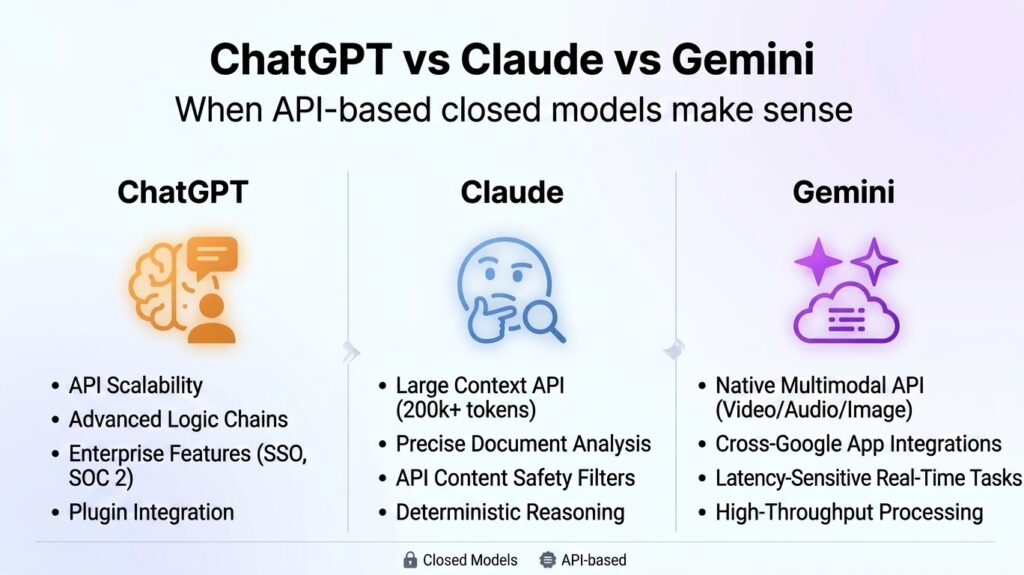
This is the right default for most funded startups, for a simple reason: you get frontier-level quality with zero infrastructure to manage, pay-per-use pricing that scales with your actual usage, and continuous improvement as providers ship new model versions — you benefit from their R&D without doing any of it yourself.
This is the right call when your data isn’t so sensitive that it can’t leave your infrastructure (most providers now offer no-training-on-your-data guarantees on API/enterprise tiers, which resolves this for many cases), your volume doesn’t yet justify the fixed cost of self-hosting, and you want engineering time spent on your product, not on model infrastructure.
When open-source / self-hosted models make sense
Data residency or strict compliance requirements. If your regulatory environment or a customer contract requires that data never leaves your infrastructure or a specific region, self-hosted open-source models (or a VPC-deployed option from a cloud provider) may be the only viable path.
Cost at very high volume. If you’re making millions of LLM calls a month, the economics can flip — self-hosting a well-chosen open-source model on your own GPU infrastructure (or through a lower-cost inference provider) can undercut API pricing significantly, though you need real volume to make the fixed and operational costs worth it.
Latency-critical applications. Self-hosted models on dedicated infrastructure, or fast inference providers like Groq, can beat general-purpose API latency for applications where every hundred milliseconds matters — real-time voice, for example.
Fine-tuning for a narrow, high-volume task. If you have a specific, repetitive task (classification, extraction from a consistent document format) and enough labeled data, a fine-tuned smaller open-source model can match or beat a general-purpose closed model’s accuracy on that narrow task at a fraction of the cost and latency.
The hybrid pattern most production systems actually use
Very few production AI systems use a single model for everything. The pattern that works: route by task complexity and cost sensitivity. Simple classification or extraction tasks go to a cheap, fast model (GPT-4o-mini, Gemini Flash, or a fine-tuned open-source model). Complex reasoning, nuanced generation, or high-stakes outputs go to a stronger model (GPT-4o, Claude, Gemini Pro). This routing decision, done well, can cut your API costs 50-70% compared to sending every request to the most expensive model by default — and it’s a design decision, not an afterthought, so it needs to be part of your architecture from the start.

Questions to actually ask before choosing
Does my data have compliance or residency constraints that rule out a third-party API? Do I have real, current volume that would make self-hosting economically sensible, or am I optimizing for a scale I don’t have yet? Is my task narrow and repetitive enough that a fine-tuned smaller model could match a general model’s quality at lower cost? How much operational capacity does my team have to manage model infrastructure, monitoring, and updates if I self-host?
For the large majority of funded startups building a vertical AI product in year one or two, the honest answer to most of these questions points toward starting with API-based closed models, with a routing layer to manage cost, and revisiting self-hosting once you have real volume and a clear economic case — not before.
Avoid the trap of choosing based on hype
New model releases generate a lot of noise, and it’s tempting to chase the newest, most-discussed model for every use case. Model choice should be driven by your actual requirements — cost, latency, data sensitivity, task complexity — evaluated against your own test set, not by which model has the most Twitter engagement this month. Build your evaluation harness once, and you can swap models behind it as better or cheaper options come out, which is a much healthier long-term position than betting your architecture on one model’s continued dominance.
CTA: If you’re weighing model choice for a specific feature and want a grounded recommendation instead of a hot take, bring the details to a short call at nextpak.org. Nextpak has been building on both closed and open-source models since before it was the obvious default.