
What actually drives the cost
Before ranges, understand the cost drivers, because they’re what let you move a project up or down in price:
Integration complexity — does the AI feature need to talk to your existing systems (CRM, billing, database, auth), or is it relatively standalone? Every integration point adds discovery time, testing surface, and failure modes.
Data readiness — is your source data clean and structured, or is it messy PDFs, inconsistent formats, and scattered systems that need normalization before AI can touch them? Data cleanup is frequently the most underestimated cost in an AI project.
Accuracy and compliance bar — a fintech or healthtech feature with audit logging, explainability, and human-in-the-loop requirements costs meaningfully more than a low-stakes internal tool with the same basic architecture, because of the extra validation, logging, and testing layers required.
Novelty — a RAG chatbot over your docs is now a well-understood pattern with predictable cost. A genuinely novel AI workflow nobody’s built before (which is rarer than founders think — most “novel” ideas map to known patterns) costs more because of the discovery and iteration required.
Real price ranges by feature type
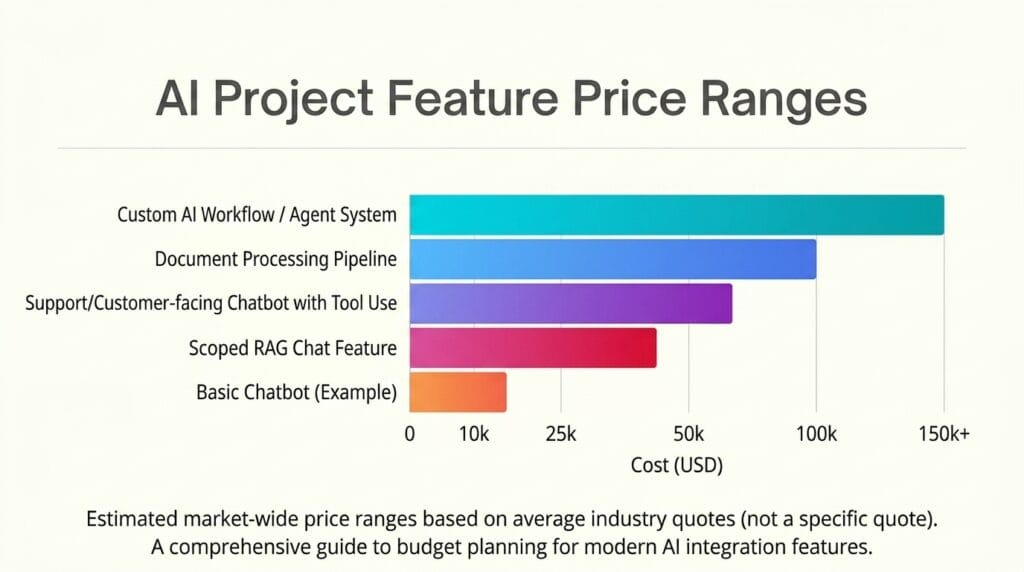
A scoped RAG chat feature (chat over your product docs or knowledge base, with retrieval, basic guardrails, and a simple UI): typically $15K-25K, 4-8 weeks. This is the most standardized AI MVP pattern in 2026 and the cost has come down as the tooling has matured.
A support/customer-facing chatbot with tool use (routing, RAG, function calling into your existing systems, escalation logic): typically $25K-40K, 6-10 weeks. The range depends heavily on how many internal systems it needs to integrate with.
A document processing pipeline (OCR, structured extraction, validation, review UI): typically $20K-40K, 6-12 weeks, driven mostly by document variety and how strict your accuracy/validation requirements are.
A custom AI workflow or agent system (multi-step automation, multiple tool calls, orchestration logic): typically $30K-60K+, 8-16 weeks, because these systems need more evaluation and failure-mode testing given the larger action surface.
A full AI-native feature embedded in your core product (the AI capability is the product’s differentiator, not a bolt-on): $40K-80K+ and often the start of an ongoing relationship rather than a single deliverable, because these tend to need continuous iteration post-launch.
What’s not in these numbers
These ranges cover design and build of a working, production-grade system. They typically don’t include: ongoing model API costs (usage-based, separate from build cost — budget $500-5,000+/month depending on volume and model choice), long-term maintenance and iteration after initial launch, or a full internal AI team if you decide to bring the capability in-house afterward.
Why “just use ChatGPT” estimates are misleading
A lot of founders see live demos built by wiring the OpenAI API directly into a simple UI and assume that’s the actual cost of “an AI MVP” — a few days, minimal cost. That demo is real, but it’s not production software: no evaluation harness, no error handling, no cost controls, no guardrails against misuse, no integration with real data or existing systems. The distance between a working demo and a system you’d trust with real customers and real data is most of the actual engineering effort, and it’s the part that doesn’t show up in a slick five-minute video.
How to scope a budget that survives contact with engineering
Get specific about the actual workflow before pricing anything: what data does the system need access to, what existing systems does it integrate with, what’s the accuracy bar, and what happens when it’s wrong. A founder who can answer those four questions gets a much tighter, more honest quote than one who says “we want an AI chatbot.” Vague scope produces vague — usually low — estimates that blow up once real requirements surface mid-build.
The other lever worth knowing about: a small, low-cost working prototype (sometimes free, depending on scope) is sometimes the right first step before a full engagement — it proves out the hardest technical risk in your idea cheaply, before you commit $30K+ to the full build. This only makes sense for genuinely novel ideas where technical feasibility is the real question; for well-understood patterns like RAG chat or document extraction, you can usually go straight to a scoped build.
The bottom line
Most funded startups building a real, scoped AI feature in 2026 should budget somewhere in the $15K-50K range for the initial build, with wide variance depending on integration complexity and compliance requirements. If a quote comes in dramatically below that for genuine production scope, ask hard questions about what’s being cut — evaluation, guardrails, and error handling are the corners that get cut first, and they’re the ones that matter most once real users show up.
CTA: Bring us your actual feature idea and we’ll give you a real number, not a range — short call at nextpak.org. NextPak has scoped and shipped AI systems at this size since 2020.