
An AI proof of concept can demonstrate what a model is capable of. Turning that experiment into a dependable enterprise system is a different challenge. The solution must work with existing applications, access the right information, protect sensitive data, handle failures, and deliver results that can be measured.
For CTOs, founders, and product managers, the key decision is not simply which AI model to use. It is how to design a system in which AI can operate reliably within real business workflows.
This guide explains the architecture behind enterprise AI implementation, how to choose an appropriate technical approach, and what businesses should consider before moving from experimentation to production.
What Enterprise AI Implementation Actually Involves
Enterprise AI implementation is the process of integrating AI capabilities into business applications, operational workflows, and decision-support systems. It includes much more than model selection.
A production implementation typically involves:
- Business workflow design: Identifying where AI can improve an existing process.
- Data engineering: Connecting, preparing, and governing the information AI needs.
- Model integration: Selecting and connecting suitable AI models.
- Application development: Building interfaces, APIs, and workflow integrations.
- Security and governance: Managing access, privacy, permissions, and risks.
- Evaluation and monitoring: Measuring accuracy, reliability, cost, and business impact.
Consider a company that wants to automate internal document searches. Connecting a language model to a chat interface is only the beginning. The system must retrieve relevant documents, respect employee permissions, identify suitable sources, and handle questions it cannot answer confidently.
The central principle: Design AI around the business process, not around the model alone.
The Core Architecture of an Enterprise AI System
A practical enterprise AI architecture separates responsibilities into layers. This makes the system easier to maintain, test, secure, and extend.
1. Application and workflow layer
This is where employees or customers interact with AI through a web application, internal portal, customer support interface, or existing business software.
The application layer manages user input, displays responses, and connects AI capabilities to business tasks. It should also determine when human approval is necessary before an AI-generated recommendation becomes an action.
For example, an AI assistant may draft a customer response automatically while requiring an employee to approve refunds or account changes.
2. Data and integration layer
AI systems depend on relevant, accessible, and appropriately governed information. Enterprise data may reside in databases, document repositories, CRM platforms, ERP systems, and internal APIs.
The integration layer connects these sources while controlling how information moves through the system. It may include data validation, document processing, indexing, permissions, and synchronization.
Before implementation, establish:
- Which data sources are authoritative.
- Who can access each information source.
- How frequently information must be updated.
- Whether sensitive information requires masking or restricted processing.
- How data quality and access failures will be handled.
Poor data quality or outdated documents can undermine an otherwise capable AI solution.
3. AI orchestration and model layer
This layer manages interactions between the application, AI model, tools, and business logic.
Depending on the use case, it may handle prompt construction, model selection, retrieval, tool calls, output validation, retries, and fallback behavior. A model gateway can also help centralize provider configuration, access controls, usage tracking, and routing.
Not every application needs a complex agent framework. A straightforward request-and-response workflow may be more reliable and easier to maintain than an autonomous multi-step system.
Choose the simplest architecture that satisfies the actual requirements.
4. Security, governance, and observability
Enterprise AI needs controls beyond conventional application security.
Authentication, role-based permissions, encryption, secrets management, audit logs, and data-retention policies help protect the surrounding system. Additional AI-specific controls may be needed to address prompt injection, unsafe tool calls, sensitive-data exposure, and unsupported model outputs.
Observability should track operational and AI-specific signals, including response latency, failures, token usage, cost per task, and evaluation results. Human review or sampled quality checks can reveal problems that ordinary uptime monitoring misses.
Choosing the Right AI Implementation Approach
Different use cases require different technical approaches. Selecting the most complex option does not automatically produce the best solution.
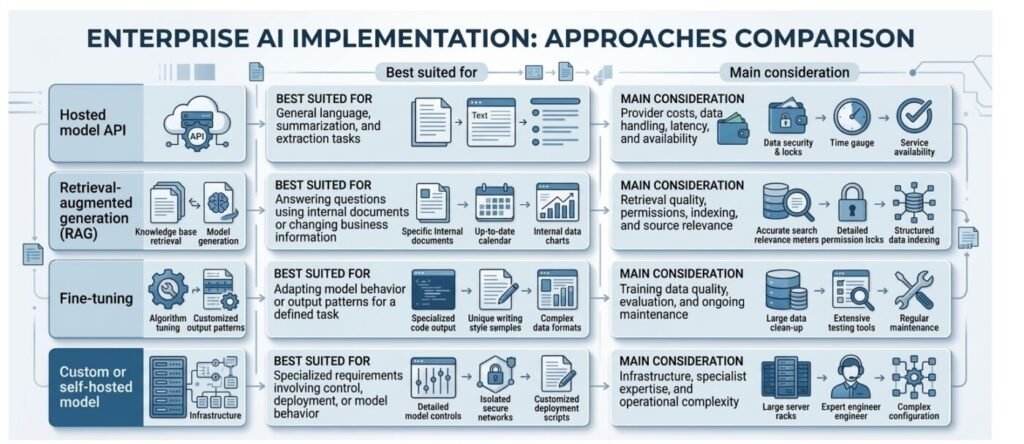
For many knowledge-based enterprise applications, RAG is a useful starting point because it retrieves relevant information at query time rather than relying entirely on knowledge embedded in model parameters. However, it still requires careful document preparation, access control, retrieval evaluation, and source-grounded response design.
Fine-tuning is not a substitute for a reliable knowledge-retrieval system when the main requirement is access to frequently changing documents.
Before committing to an approach, test it against representative tasks and compare quality, latency, security requirements, and total operating cost.
A Practical Enterprise AI Implementation Roadmap
A phased process helps teams validate business value before committing to a large-scale deployment.
Step 1: Identify the business problem
Select a workflow with a clear operational challenge, such as repetitive document processing or lengthy internal information searches. Define measurable outcomes before choosing technology.
Step 2: Assess data and system readiness
Map data sources, application dependencies, permissions, data quality, and integration constraints. Identify sensitive information and relevant compliance requirements.
Step 3: Design the architecture
Define application boundaries, APIs, model access, retrieval mechanisms, authorization, logging, and failure handling. Establish how the AI component will interact with existing systems.
Step 4: Build a focused prototype
Implement the smallest useful workflow using representative data. Test realistic inputs, ambiguous requests, missing information, and expected failure conditions.
Step 5: Evaluate quality and risk
Create test cases based on real tasks. Measure task success, factual accuracy, response consistency, latency, and cost. Assess security risks and define when human intervention is required.
Step 6: Integrate and deploy
Connect the solution to production systems using appropriate access controls, versioning, testing, and release procedures. Roll out gradually where possible rather than exposing every user or workflow immediately.
Step 7: Monitor and improve
Track operational performance, user feedback, changing data, and model behavior. Re-evaluate the system when prompts, models, integrations, or source data change.
This process should be iterative. A prototype may reveal that the workflow needs better data preparation rather than a different model, or that a human approval step is necessary before automation can safely expand.
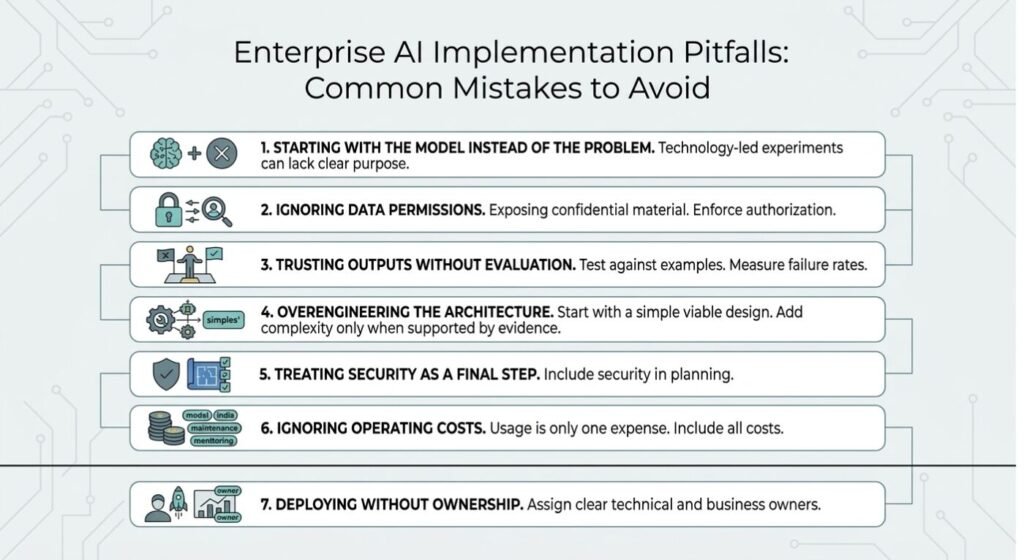
Common Enterprise AI Implementation Mistakes
Build In-House or Work With a Dedicated Development Team?
An internal team may be the right choice when it already has AI engineering expertise, available capacity, and the operational knowledge needed to maintain the system.
External development support becomes useful when the organization understands the business opportunity but lacks specialist skills, integration capacity, or enough engineers to deliver without disrupting its existing roadmap.
A dedicated development team can provide ongoing engineering capacity across architecture, backend and frontend development, data integration, AI implementation, QA, and deployment. The exact responsibilities should be defined in the engagement scope.
Before selecting a provider, assess its experience with production software, API integrations, testing, security practices, documentation, and maintainable architecture. Clarify ownership of code, infrastructure, technical decisions, and ongoing support.
How Dedicated Software Development Teams Support Enterprise AI
The challenge in enterprise AI is rarely limited to connecting a model. The larger task is building and maintaining the software around it: integrating business systems, managing data access, validating outputs, testing failure scenarios, and improving the workflow after deployment.
This is where a dedicated software development team can be valuable. It gives businesses a structured way to add engineering capacity while retaining visibility into priorities, delivery, and technical decisions.
NextPak’s dedicated software development teams are the relevant service to explore when an enterprise AI initiative requires additional development capacity. Depending on agreed project requirements, the team structure can be aligned with backend and frontend development, integrations, QA and testing, and ongoing product engineering.
The right engagement should begin with a clear assessment of the use case, existing systems, internal capabilities, security requirements, and delivery goals—not a predetermined technology stack.
Planning an enterprise AI initiative? Discuss your requirements with NextPak to evaluate the engineering skills and team structure your project needs. Explore the dedicated software development team service to determine whether this model fits your roadmap.
Frequently Asked Questions
What is enterprise AI implementation?
It is the process of integrating AI into business systems and workflows, including data preparation, model integration, application development, security, evaluation, deployment, and monitoring.
How long does enterprise AI implementation take?
The timeline depends on scope, data readiness, integration complexity, security requirements, and evaluation needs. A focused prototype generally requires less work than a production system connected to multiple enterprise platforms. Establish milestones after discovery.
Is RAG necessary for enterprise AI?
No. RAG is useful when an application needs to retrieve information from external or internal knowledge sources. Other tasks may work better with direct model calls, traditional software logic, fine-tuning, or a combination of approaches.
How can businesses protect sensitive data in AI systems?
Use appropriate access controls, data minimization, encryption, secure secrets management, audit logging, and clear retention policies. Review model-provider data handling and test whether retrieval and tool access preserve user permissions.
What affects the cost of enterprise AI implementation?
Major cost drivers include engineering effort, data preparation, integrations, model usage, infrastructure, testing, security controls, human review, and ongoing maintenance. Estimate costs against expected workload and measurable business outcomes.
When should a business hire a dedicated development team?
Consider one when the project needs sustained engineering capacity or specialized skills that the internal team cannot provide without delaying other priorities. Define responsibilities, technical ownership, deliverables, and communication processes before engagement.
What should businesses measure after deployment?
Track business outcomes alongside technical performance. Depending on the use case, metrics may include task completion rate, processing time, error rate, user adoption, cost per task, response latency, and the frequency of human intervention.
Build Your Enterprise AI Solution with the Right Engineering Team
Moving AI into production requires the right architecture, secure integrations, and reliable software engineering. NextPak’s dedicated software development teams can help you add the engineering capacity needed to implement, test, and scale your AI initiatives.
Discuss your project requirements with NextPak and identify the right development team for your roadmap.