
A product roadmap can be full of promising features while development remains frustratingly slow. Frontend changes depend on backend updates, API contracts keep shifting, testing happens late, and developers spend more time coordinating than delivering. Adding more people will not automatically solve these problems. Without clear architectural ownership, it can make them worse.
Hiring a full-stack developer team can help businesses reduce unnecessary handoffs and move features from concept to deployment with greater continuity. But the real advantage is not simply having developers who work across frontend and backend technologies. It is building a team that makes sound technical decisions, understands the complete product, and improves delivery without creating avoidable maintenance problems.
This guide explains how to hire a full-stack developer team, evaluate its architectural capabilities, choose the right engagement model, and establish a development process that supports sustainable velocity.
What Is a Full-Stack Developer Team?
A full-stack developer team combines the skills required to build and maintain different layers of a software product. Depending on the project, these layers may include frontend interfaces, backend services, APIs, databases, integrations, and deployment workflows.
For example, a SaaS application might require React or Next.js for the interface, Node.js for backend services, PostgreSQL for data storage, and automated tests to protect important workflows. A capable team understands how these components interact rather than treating each as an isolated task.
A full-stack team can be structured in several ways:
- A small product team: Full-stack developers handle most features, supported by occasional specialist input.
- A cross-functional team: Full-stack developers collaborate with QA engineers, designers, and technical leads.
- A dedicated engineering team: Developers work continuously on your product, follow agreed priorities, and build knowledge of its architecture over time.
The right structure depends on product complexity, delivery expectations, and the expertise already available in-house.
Why Architecture Determines Development Velocity
Architectural velocity is the ability to deliver useful changes efficiently while keeping the software understandable, reliable, and adaptable. It is not the same as writing code quickly.
Consider a feature that requires a new dashboard, an API endpoint, database changes, and permission checks. If frontend and backend responsibilities are unclear, developers may wait for one another, duplicate work, or discover integration problems late in the sprint.
A well-structured team can reduce this friction by agreeing on data contracts, defining responsibilities, reviewing dependencies, and testing the feature across the system.
Three architectural practices make a difference:
- Clear component boundaries. Each module should have a defined responsibility. This makes it easier to modify one part of the application without unexpectedly breaking another.
- Consistent API and data contracts. Frontend and backend developers should agree on request formats, response structures, validation rules, and error handling before implementation becomes dependent on assumptions.
- Automated quality checks. Unit, integration, and end-to-end tests help identify regressions before they reach users. Continuous integration can make these checks part of the development workflow.
Architecture should not mean designing every future possibility in advance. Overengineering can slow a product just as much as poor design. The objective is to make deliberate decisions that fit current requirements while leaving reasonable room for growth.
What Should a Full-Stack Team Include?
Not every project needs a large engineering department. Start with the capabilities necessary to deliver your roadmap, then add specialists when the workload justifies them.

Some responsibilities can be shared in a small team. However, sharing responsibilities does not mean leaving them unassigned.
For example, developers may write automated tests, but someone must still own the overall testing strategy. A senior engineer may make architecture decisions, but the team needs a clear process for reviewing and documenting them.
When evaluating candidates, look beyond the number of technologies listed on their profiles. Ask whether they can explain trade-offs, investigate production issues, design maintainable APIs, and work effectively with other engineers.
How to Choose the Right Hiring Model
Hiring individual developers is not always the same as hiring a team. Choose the model according to the ownership, continuity, and management support your project needs.
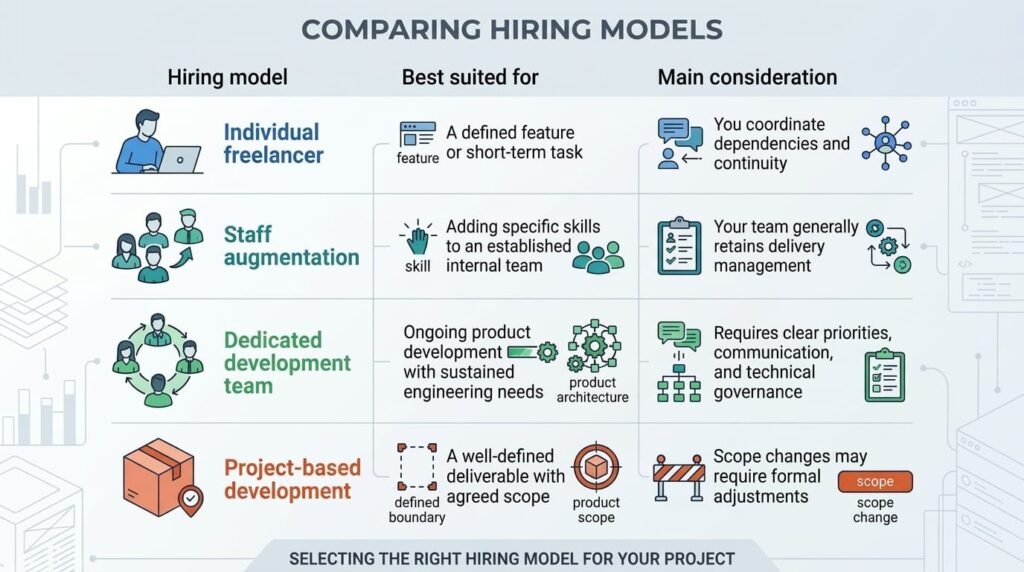
A dedicated team is particularly useful when requirements evolve, product knowledge accumulates over time, and development continues beyond a single release. The same team can learn the codebase, understand business rules, and improve its approach across successive iterations.
Staff augmentation may be more appropriate when you already have strong technical leadership and need one or two additional engineers. Project-based delivery can work well when the outcome and acceptance criteria are sufficiently clear.
The key question is not which model is universally best. It is which model gives your product the right combination of capability, ownership, and flexibility.
How to Evaluate a Full-Stack Team Before Hiring
A technical interview should test how a team approaches real engineering decisions, not just whether its members can complete isolated coding exercises.
Use this checklist when evaluating a potential partner:
- Architecture: Ask how they would structure your application and why. Look for reasoning about boundaries, dependencies, data flow, and future changes.
- Technical depth: Confirm that the proposed team has relevant experience with your stack, integrations, and infrastructure.
- Testing discipline: Ask how they validate features, prevent regressions, and handle defects discovered after deployment.
- Security: Discuss authentication, authorization, input validation, secrets management, and protection of sensitive data.
- Communication: Establish who reports progress, raises blockers, documents decisions, and communicates risks.
- Code ownership: Clarify repository access, intellectual property terms, documentation, and handover responsibilities in the contract.
- Delivery process: Ask to see how requirements become tasks, how work is reviewed, and how completed features are demonstrated.
A useful evaluation exercise is to present a small, hypothetical product requirement and ask the team to explain its proposed architecture, implementation sequence, testing approach, and likely risks.
You are evaluating the quality of their reasoning as much as their proposed solution.
Common Mistakes When Hiring Full-Stack Developers
- Hiring for technology lists alone. A long list of frameworks does not demonstrate sound engineering judgment. Assess practical experience and decision-making.
- Expecting one developer to cover every specialty. Full-stack capability is broad, but advanced security, infrastructure, performance, or data engineering may require specialists.
- Treating architecture as a one-time activity. Products change. Review important technical decisions as requirements and operational needs evolve.
- Skipping discovery and onboarding. Without access, documentation, domain knowledge, and clear acceptance criteria, developers lose time resolving avoidable uncertainty.
- Measuring activity instead of outcomes. Lines of code and hours logged are weak measures of product progress. Review working features, quality, cycle time, and unresolved risks together.
- Ignoring maintainability to meet deadlines. Shortcuts can accumulate into technical debt that makes future delivery slower. Record deliberate compromises and establish when they should be addressed.
From Hiring to Delivery: A Practical Implementation Plan
A successful engagement needs more than a signed contract. Establish a repeatable workflow that connects business priorities to technical execution.
Step 1: Define the product goal
Identify the user problem, required outcomes, essential features, constraints, and acceptance criteria.
Step 2: Review the architecture
For an existing product, assess the codebase, dependencies, infrastructure, integrations, security concerns, and known technical debt. For a new product, agree on an appropriate initial design.
Step 3: Establish team responsibilities
Assign ownership for architecture, implementation, testing, deployment, and product decisions. Make escalation paths explicit.
Step 4: Plan small delivery increments
Break the roadmap into manageable features with clear acceptance criteria. Prioritize work that delivers value and reduces significant technical uncertainty.
Step 5: Build and validate continuously
Use code reviews, automated tests, integration checks, and regular demonstrations to identify problems early.
Step 6: Deploy and monitor
Define release procedures, rollback options, logging, monitoring, and incident responsibilities appropriate to the product.
Step 7: Review and improve
Use retrospectives and delivery evidence to identify bottlenecks, improve collaboration, and address technical debt.
This process helps teams make progress visible without assuming every sprint will go exactly as planned.
When Should You Hire a Dedicated Full-Stack Team?
Your internal team may be sufficient when the product scope is manageable, the necessary expertise is available, and the roadmap can be delivered without persistent capacity constraints.
External support becomes worth considering when several conditions appear together:
- Product commitments exceed the capacity of the current engineering team.
- Frontend, backend, integration, and QA work require more coordinated delivery.
- Important skills are missing internally and recruiting would delay the roadmap.
- Product development is ongoing and benefits from consistent team knowledge.
- Leadership needs additional execution capacity without immediately expanding permanent headcount.
Before hiring, identify the actual bottleneck. If delays come primarily from unclear requirements or slow decision-making, adding developers alone may not help. If the problem is insufficient engineering capacity or missing expertise, a dedicated team may provide a more direct solution.
How NextPak Can Support Your Engineering Roadmap
When a product needs sustained development, the challenge is not simply finding developers who can code. It is establishing a team that can understand the product, work within your delivery process, and contribute across the software lifecycle.
NextPak provides dedicated development and engineering support for businesses and software agencies that need additional delivery capacity. Its published technology capabilities include React, Next.js, TypeScript, Node.js, Python, APIs, databases, and cloud and DevOps tools. The appropriate team composition depends on your product and requirements.
Explore NextPak’s technology stack to review relevant capabilities, or visit its dedicated developer and agency offering to explore available engagement options.
Before committing, discuss your roadmap, required skills, technical leadership needs, communication expectations, and quality standards. A clear starting scope helps both sides determine whether the proposed team is a suitable fit.
Need more engineering capacity without losing architectural direction? Book a 15-minute call with NextPak to discuss your requirements and explore matching developer profiles. The objective is to identify a practical team structure for your roadmap—not simply to add more people.
Frequently Asked Questions
What does it mean to hire a full-stack developer team?
It means engaging developers who can work across frontend and backend layers, often with supporting expertise in testing, design, infrastructure, or technical leadership. The team structure depends on the product and its complexity.
Is a full-stack team better than separate frontend and backend teams?
Not always. Full-stack teams can reduce handoffs and support end-to-end feature ownership. Larger or highly specialized systems may benefit from dedicated frontend, backend, platform, or data teams. Choose based on dependencies and technical complexity.
How many developers should a full-stack team have?
There is no universal team size. A focused product may start with one or two experienced full-stack developers and shared specialist support. More complex products may require a technical lead, QA engineer, designer, or additional developers.
Should I choose a dedicated team or staff augmentation?
Choose a dedicated team when you need sustained product development and coordinated execution. Choose staff augmentation when your existing team can manage delivery but needs additional individual skills or capacity.
How can I assess a team’s architecture skills?
Ask for a technical walkthrough, discuss trade-offs, and use a realistic sample requirement. Evaluate API design, data modeling, testing, security, maintainability, and how clearly the team explains its decisions.
How do I maintain control when working with an external team?
Define product ownership, repository access, code review requirements, documentation standards, sprint reviews, reporting, and decision-making responsibilities. Keep priorities and acceptance criteria visible to everyone involved.
What should I prepare before hiring a full-stack team?
Prepare a product brief, current architecture or initial requirements, preferred technology stack if known, expected outcomes, timeline constraints, and any security or integration requirements. You do not need every technical decision finalized before the first discussion.
Need a Full-Stack Team That Can Support Your Product Roadmap?
Scaling software development requires more than adding developers. You need the right technical expertise, clear architectural ownership, reliable testing practices, and a delivery process that keeps your product moving forward.
NextPak offers dedicated development and engineering support for businesses and software agencies looking to expand their development capacity. From frontend and backend development to API integrations and QA, the right team structure depends on your product requirements and technical priorities.
Explore NextPak’s technology stack to review relevant capabilities, or visit the dedicated developer and agency offering to explore engagement options.
Ready to strengthen your engineering capacity? Book a 15-minute call with NextPak to discuss your roadmap, identify the skills you need, and explore suitable developer profiles.