1. Can they show you real profiles, not a generic pitch deck?
Ask for actual developer profiles matched to your specific role — not a slide with stock photos and buzzwords. A partner with a genuine bench should be able to send 2-3 real, relevant profiles within a day or two of hearing your requirements. If they need two weeks to “find someone,” they’re not running a bench model — they’re recruiting from scratch after you’ve already signed.
2. What’s the actual timezone overlap, not just “we work your hours”?
Get specific. If you’re a Chicago-based agency, ask exactly which hours the developer will be online and responsive. “We work flexible hours” is a red flag — you want committed overlap, ideally 4-6 hours of your working day, so blocking questions get answered same-day, not next-day.
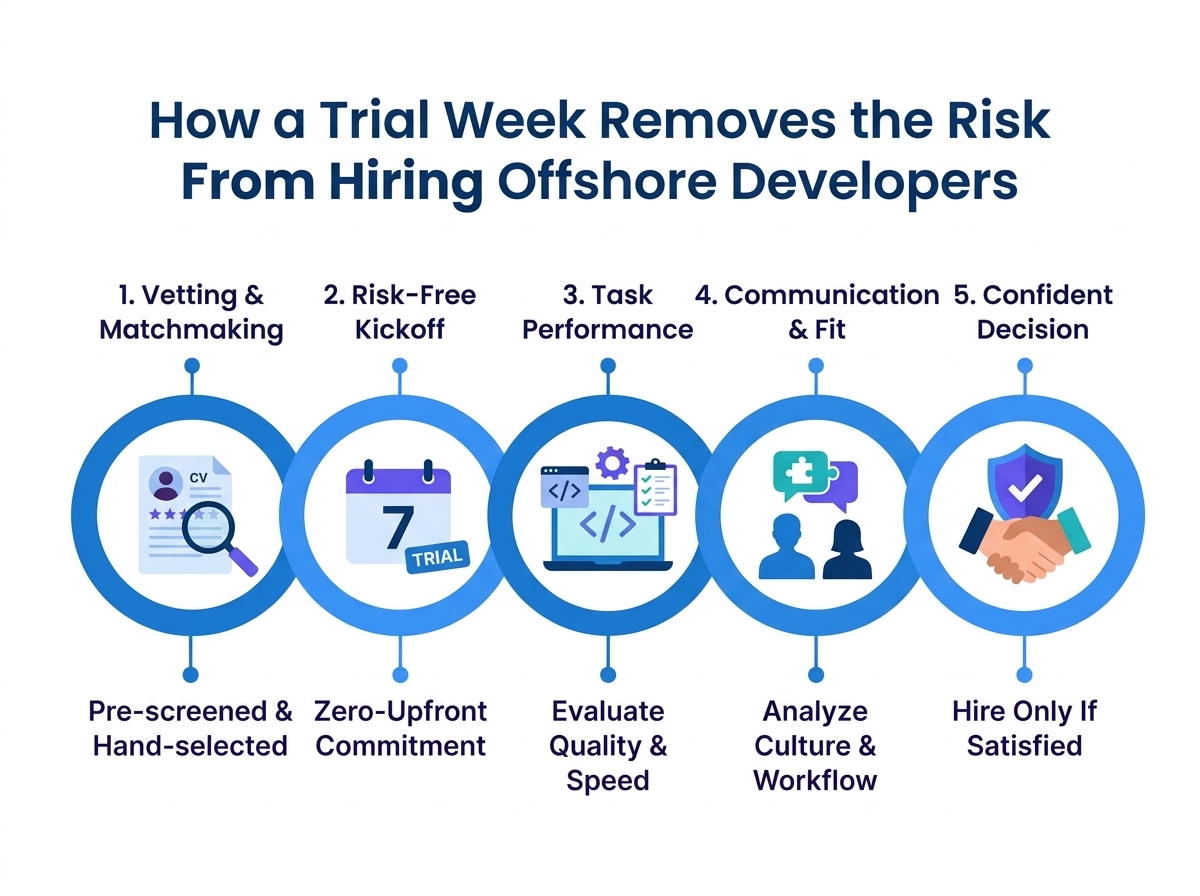
3. Is there a paid trial period before you commit long-term?
A short paid trial — a week, a few hundred dollars — lets you evaluate actual output and communication before signing a longer commitment. If a partner insists on a full month minimum with no trial option, that’s a sign they’re not confident enough in the match to let you test it cheaply.
4. What happens if the fit is wrong in week one?
This is the single most revealing question. A partner with a real replacement guarantee — free, fast, no penalty — has skin in the game. A partner who hedges, adds conditions, or charges a switching fee is telling you the risk sits entirely with you.
5. Who do you actually communicate with day-to-day?

You want direct access to the developer — Slack, Jira, standups — not a account manager relaying messages back and forth. Layers of communication slow everything down and strip out nuance.
6. Can you verify English fluency before you commit?
Ask for a live call with the actual developer, not a recruiter, before finalizing. Written English on a resume tells you nothing about real-time communication during a standup or a client escalation.
7. What’s the bench size, actually, for the role you need?
“We have developers available” means nothing without specifics. Ask how many people are on the bench for your exact role — Senior MERN, Node.js, Vue/Nuxt, mobile, AI integration, QA — and current availability. A partner juggling every client against the same three people isn’t really running a bench.
8. Do they have experience with agency-specific delivery, not just direct-client work?
Working inside an agency’s delivery process — white-labeled, client-facing indirectly, coordinated through your PM — is different from working for a startup founder directly. Ask if they’ve done it before and ask for a specific example.
9. What tools and process do they expect you to provide vs. what they bring?
Clarify who owns onboarding, documentation, and access provisioning. A good partner has a lightweight, repeatable onboarding process they walk you through, not a blank stare when you ask “so how does day one actually work?”
10. How fast can a new developer actually start?
Get a real number. Five to seven days from agreement to full-time start is realistic for a bench-based model. If the estimate is three to four weeks, they’re recruiting externally, which reintroduces the timeline and quality risk you were trying to avoid.
11. Can you see evidence of real, similar shipped work?
Ask for examples — even generic, anonymized ones — of comparable projects: e-commerce builds, SaaS platforms, mobile apps, AI integrations, whatever matches your need. Vague claims of “we’ve built everything” without specifics are a yellow flag.
12. What does the rate actually include?
Get clarity on what’s bundled into the monthly rate — is PM overhead included, are there setup fees, is there a minimum commitment period, what happens with overtime or scope changes. Surprise line items after signing are the most common source of partner regret.
Why this checklist matters more than the sales call
Any partner can sound good on a discovery call. The checklist above is designed to surface how they actually operate under pressure — because that’s when it matters. A good partner will answer all twelve questions specifically and without hedging. A partner running a bodyshop model will get vague around questions 2, 4, 9, and 11 specifically, because those are the ones that expose thin process.
CTA: Run this checklist against us — book a 15-minute call and ask us all twelve questions directly, then decide. See our process and current bench at nextpak.org/agencies.